Here it is! My "Most Inspiring Films 2011!" list. These inspiring stories stayed in my heart and mind for months after I had seen them. A recurring theme this year - is the incredible strength we get from our connection with others to overcome even the greatest loss. I would love to hear about the films that moved you too! Please, share your thoughts and favorites in the comment section below.
10) "Midnight in Paris," is Woody Allen's love letter to Paris. For me it's total wish fulfilling escapism - a guilty pleasure. It is the story of a Hollywood screenwriter who joins his fiancee and her family on a business trip to Paris. The trip rekindles his dream of being a starving writer in Paris - much to the dismay of his materialistic fiancee. He takes a midnight walk and ends up in 1920's Paris. This is a dream come true for the aspiring novelist as he mingles with great artists (Picasso!) and his literary idols including Hemingway himself! This is one of the most enjoyable Woody Allen films to come out in years. The story flows effortlessly back in forth in time, earning Woody a well deserved Best Original Screenplay Oscar.
9) In "The Tree," eight-year-old Simone is riding in the back of her father's pickup when it goes off track and rolls into the sprawling, twisted tree shading her house. Her family's world is turned upside down - not only by of the loss of their father, but also by the loss of their mother when she retreats into a deep depression. Unable to accept that her father is gone, Simone begins to hear her father's voice in the tree. To be near him, she climbs high into the branches and sets up house. At first her mother is worried, but then she finds comfort in the idea that her husband is there. The next morning, the children discover their mother curled up in the roots of the tree. These roots threaten to destroy the very foundation of the house. Mom must grow up and find the strength within herself to protect her family. "The Tree" is captivating in its beauty, riveting in its action sequences, and poetic in its symbolism. It has a valuable theme on the importance of pulling together as a family to survive loss.
8) “Where were you when I laid the earth's foundation... while the morning stars sang together and all the sons of God shouted for joy?” "The Tree of Life" is a reflection on the meaning of life. The filmmaker uses the opening narration to give us a handle on how to understand the nature images and memories to follow. The mother meditates, "There are two ways through life – the way of nature and the way of grace. We have to choose the way we will follow.” Basically, nature is competitive and only cares for itself while grace relies on a sense of oneness with all of existence. Soon after the opening images and narration, we witness the family getting the news that one of their three sons has died. They try to make sense of the loss. This brings on a lot of soul searching about how the children were raised and inspires prayers requesting understanding of the meaning of life, suffering, and death.
7) Distracted by the appearance of "Another Earth" in the sky, Rhoda drives into a family's car killing mother and son and leaving the father in a coma. After being released from prison, Rhoda seems to be serving a self-induced penitence when she accepts a job as a school janitor. The radio announcer confirms that the earth has been duplicated. “There's another you out there. Has that 'me' made the same mistakes as I made? Maybe the other me made a better choice." Recognizing the opportunity for a second chance, Rhoda enters an essay contest to win a shuttle ride to Earth II. But everything changes when she sees a man leaving a toy robot by the side of the road where the accident happened. "Another Earth," looks like sci fi, but it is actually a very human drama. The discovery of Earth II acts as the framework to explore the life we create with our bad choices, the inherent regrets, self-forgiveness, and redemption. Despite the tragic circumstances; it is really a story of hope.
6) First off, I will admit that I am a fan. I am completely captivated by the fanciful flights of the imagination in the magical world of, "Harry Potter." If it were on TV right now, I would be watching Harry and his friends' quest to find and destroy Lord Voldemort's Horcruxes (the instruments of his power.) Because, "Harry Potter and the Deathly Hallows, Part 2" was one of the most compelling, suspenseful, awe-inspiring movies of the year and definitely the most satisfying ending to a franchise EVER.
5) Best Picture winner, "The Artist" is more than a homage to the silent film era, it transcends the form. Bigger-than-life movie star George Valentin (Best Actor winner Jean Dujarin) fades into oblivion with the decline of silent pictures as his young love interest, Peppy Miller, rises to stardom with the talkies. French director (Best Director winner) Michel Hazanavicius reinvents silent pictures by using a naturalistic, charismatic acting style and exquisite cinematography. You can see the love in every frame.
4) In, "The Help," recent college grad Skeeter is hired to write a housekeeping and cooking column – a subject she knows nothing about. She asks her bridge club friend if she can interview her maid Abileen. Upset by her friend's mistreatment of Abileen, Skeeter is inspired to write a book on the maids' perspective of working for a white family. Her editor reminds her that it is 1960 Jackson, Mississippi. She will never be able to get any maids willing to risk their jobs or their lives to talk to her. Skeeter explains, “We are raised by our black maids. They love us and we love them, but they can't use the same bathroom.” But it's the maids that make the story. Viola Davis, as Abileen, adds gravity to every scene she is in. In her carriage we see the weight of generations of oppression. But it's her friend Minny (Best Supporting Actor winner Octavia Spencer) you have to watch. After working for the segregationist bridge club president, Minny has had enough. She is a firecracker ready to explode. These women are survivors. But they have risen above that. They have stood up to their fears. They are heroes in their own civil rights protest and free women.
3) In, “The Descendants,” Alexander Payne and Oscar winning co-writers Nat Faxon and Jim Rash present a flawed main character - absentee husband and father Matt King (played with good humor by George Clooney). Sometimes it takes a catastrophic event to shake us awake from sleep walking through life. When his wife ends up in a coma, Matt is absolutely clueless about how to handle the life shattering situation and his two troubled daughters. Matt must come to an understanding of his wife's infidelity before he can fully be there for them.
2) "Extremely Loud and Incredibly Close." According to his dad, the way Oskar sees the world is a gift. Oskar's overly active mind continuously scrutinizes the connections he observes in order to make sense of the physical world. Things he can't observe - like people's feelings - are elusive and frightening to him. His dad would challenge him by sending him on reconnaissance missions (to learn to talk to people.) When his father is killed in the 9/11 tragedy, Oskar is ill-equipped to make sense of the senseless act. Then he discovers a key in an envelope with the word BLACK written on it and a newspaper clipping indicating that he should keep looking. Did his father leave him one last message locked away somewhere in the city that only this key can open? As Oskar compulsively traverses the five boroughs in search of the lock, he inadvertently learns the lessons his father set out to teach him about connecting with other people. The quest gives him a concrete method to deal with a tragedy that makes no sense.
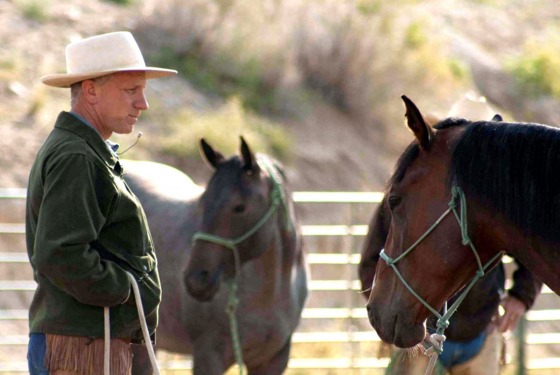
1) "Buck" is a pret'near perfect picture. You have your likable hero, Buck Brannaman, a wounded soul who overcame an abusive childhood and personal weaknesses to forge a better path in training horses. His experience taught him to be an empathetic, intuitive reader of horses and people. The thing that really stands out in this film is its humanity. Through working with their horses, the owners are transformed. They learn to let go of trying to force their will on others. “If you find a way to fit this thing right here, it'll make you better. It'll make you better in areas you didn't think related to horses.”
Movie blessings!
Jana Segal
*SCROLL DOWN FOR LONGER REVIEWS OF THESE MOVIES BELOW.


