Showing posts with label Best Adaptation Oscar Winners. Show all posts

Monday, January 12, 2015

"12 Years a Slave"

Director Steve McQueen with Best Picture Oscar
Best Picture winner, “12 Years a Slave,” is based on the empowering true story of Solomon Northup, an African-American musician and freeman, who is kidnapped and sold into slavery.

There have been many movies about the plight of the slaves. But “12 Years a Slave,” by director Steve McQueen and Oscar award-winning adapter, John Ridley, transcends the others by illuminating the importance of not only surviving, but surviving with dignity. When Solomon (Chiwetu Ejiofor) is first kidnapped, he insists that he is a freeman. In an attempt to break his spirit, his captors beat him within an inch of his life. A fellow captive advises him that if he wants to survive, he must keep a low profile and not let them know he can read and write. The hopelessness of his situation finally sets in as other slaves fail gravely in their attempts to escape. He decides to cooperate, but continues exercising to keep up his strength so he is prepared when the opportunity to escape arises. But he soon observes that cooperation doesn’t save his fellow slaves from abuse. They are considered property and are whipped or killed at their master’s whim.

SPOILER AHEAD:

Solomon finally decides to risk everything to realize himself. He demonstrates his intelligence by engineering a way for logs to be carried across the river. The master is pleased and rewards him with a violin – a show of respect (and a possible way for him to earn money to buy his freedom). The white foreman becomes jealous and attacks him, but now Solomon fights back like a man. Later, the foreman returns to hang him. The master runs the foreman off, but leaves Solomon hanging from the noose barely able to hold up his weight on his tip toes. The master punishes the foreman for messing with his property, and sends a message to Solomon to stay in his place.

The film also examines the lives of the slaves who chose to please their masters. A spirited young slave, Patsey, (Best Actress winner Lupita Nyong’o) captures her master’s attention by cheerfully picking more cotton then the rest of the slaves. He watches her dancing in the slave quarters, entranced, longing to capture her jubilant spirit. When his wife protests, he insists on keeping his slave and suggests that his wife leave if she doesn’t like it. The wife finds little ways to belittle Patsey’s dignity like depriving her of soap. Believing she is entitled to special treatment as the master’s favorite, Patsey goes off to fetch some for herself. Furious at her for trying to escape, the master beats her. She pleads with him - explaining that she was just getting soap and that she has earned the right to keep herself clean. But this angers him even more. Egged on by his wife, he forces Solomon to beat her to demonstrate to both of them that he can do what he wants with his property.

Despite his captors’ best efforts to break his spirit, Solomon Northup never gives up his identity. By exhibiting his strength as a man, he plants a seed of thought – I am a man and no man’s property! By surviving with dignity, he liberates himself and others.

Movie blessings! 
Jana Segal 
www.reelinspiration.blogspot.com

Saturday, January 02, 2010

"PRECIOUS" and "THE MESSENGER"


From Despair to Hope

Two powerful, acclaimed films, "Precious," and, "The Messenger," have heart-achingly honest performances that express the strength of the human spirit to move through despair to hope.

The synopsis of, "Precious," couldn't be more depressing. Precious, (Gabourey "Gabby" Sidibe) an obese thirteen year old, is pregnant for the second time with her father's child. Her mother (Mo'Nique) treats her as less than a servant, beating her and constantly reminding her that she is nothing. We get a glimpse of the girl's spirit as Precious escapes into her dreams of being a glamorous star. At school Precious is pretty much invisible aside from being teased for her weight. But there is one teacher who recognizes her potential in math. When Precious is kicked out of school, he recommends that she be placed in a alternative school. Her new teacher (Paula Patton) asks Precious how she felt about introducing herself to the class and Precious says she feels, "Here." The teacher assigns her a journal where she expresses herself for the first time. Precious finds the strength to get an education and keep her baby even as the abuse intensifies at home.

It is a minor miracle and a credit to director Lee Daniels, screenwriter Geoffrey Fletcher, and actress Gabby Sidibe that you leave the theater actually feeling hopeful. The film demonstrates the transforming power of having one person - in this case a teacher - who believes in you. Precious illustrates the strength of the human spirit to survive extreme abuse and find hope.

In, "In the Messenger," war "hero" Will Montgomery (Ben Foster) returns from Iraq and is assigned to the Army's casualty notification service. He has not gotten any grief counseling since receiving his own battle wounds - just a quick lesson in protocol from his jaded partner Tony Stone (Woody Harrelson) who instructs the soldier to avoid physical contact or hugging the N.O.K. (next of kin.) Ben assures him, "I'm not going to be offering any hugs."

Will has come home to a lonely apartment and an empty life. (When he went off to war he broke up with his girlfriend.) He diligently carries out his duty, but the grief of the families of the deceased hits close to home. He finds himself drawn to a widow with a brave facade. Her husband's story brings out his own neglected issues. Will his "war scars" heal so he can be a decent husband and father? Or should he reenlist because war is the only thing he is still good for? Somehow he finds the strength to choose life. "The Messenger," shows the resiliency of the human spirit to move through grief to hope.

Movie blessings!
Jana Segal
www.reelinspiration.blogspot.com

OSCAR ALERT:

Mo'Nique won Best Supporting Actress, Geoffrey Fletcher won Best Adapted Screenplay

Thursday, January 01, 2009

"Frost/Nixon"


OK. I'm sappy when it comes to our country. I cry when I hear the national anthem. I wept as I watched the airplanes crash into the World Trade Center not only for the lost lives but because I suspected it would result in some loss of our freedom as Americans. And I still have unresolved feelings of anger that our country was misled and polarized by the Bush administration.

There are two biopics in theaters now that deal with presidents who shattered Americans' trust in our government. I believe that biopics can be very powerful when they deal with our unresolved issues. I went to these films to find some kind of understanding and resolution. Unfortunately, the film "W" doesn't begin to deal with my issues with Bush. Oddly, director Oliver Stone seems to make excuses for Bush. No matter what he did, party boy George could never win his daddy's approval. Maybe I'm not there yet, but I have no need to sympathize with the spoiled rich kid portrayed here. This shallow justification was just as unsatisfying as the acting. I was always keenly aware that I was watching an actor (Josh Brolin) playing the President.

"Frost/Nixon" is based on the famous news special in which British talk show host, David Frost (Michael Sheen), tried to coax a confession out of former President Richard Nixon (Frank Langella) for his part in Watergate after he is pardoned by President Ford. Media savvy David risks an insanely huge sum of money for the interview in hopes of getting commercial sponsors and more credibility so he can get back his New York talk show and his table at Sardi's. I found myself rooting for this second rate talk show host to convince the intellectually superior Nixon to finally take responsibility for the cover up and for hurting the American people. I discovered, along with Frost, the importance of uncovering the truth as a much needed resolution. The acting and the writing (Peter Morgan) are thoroughly compelling. I wasn't watching actors, I was watching Frost and Nixon. It was a pleasure watching them in their "no holds barred" debate.

I found "Frost/Nixon" infinitely more satisfying than "W". Director Ron Howard wisely saw America's need for the truth and addressed it. Hmm. Perhaps we could use a "Frost/Bush" interview...

Movie Blessings!
Jana Segal

OSCAR UPDATE

Frost/Nixon Won Best Picture, Frank Langella won Best Actor, Ron Howard won Best Director, Peter Morgan won Best Adapted Screenplay, Mike Hill and Daniel P. Hanley won Best Editing

Monday, December 29, 2008

"Slumdog Millionaire"


by guest reviewer Josh Valentine
Indiebum

Is America ready for Bollywood? With filmmakers like Danny Boyle integrating Bollywood styles with his own terrific, seasoned style in his new film “Slumdog Millionaire,” cultural cinema desegregation is not the final answer in modern filmmaking – it is the beginning of something new. Without a doubt, Boyle’s new work is a masterpiece, proving he is one of our greatest directors of this generation.

“Slumdog Millionaire” is the story of Jamal Malik (Dev Patel), a young man under suspicion after a winning streak on India’s version of “Who Wants to be a Millionaire?” In America that show has become somewhat irrelevant (is it even on anymore?) but for Jamal, the show means everything. Not for the money, but for his one and only love Latika (Frieda Pinto) who he feels he can win by appearing on her favorite program.

We learn that Jamal has lived a very interesting life - one might consider a sometimes dangerous life. But for Jamal this life has taught him the answers he needs to become the man he is destined to become. Coincidentally, those answers are the strangely yet inventively the answers to the questions he is asked on the television program. First-time Boyle collaborator Simon Beaufoy (the Oscar nominated writer of “The Full Monty”) intertwines beautifully the story of Jamal’s fruitful life and the questions on the program to paint the intriguingly poignant story of his main character’s growth. It’s genuinely refreshing to see film narrative portrayed in such an original way, and Beaufoy’s script is simply one of the best this year.

While Beaufoy’s script has not gone unnoticed in critics’ circles, something that may be missed is the strong performance of Dev Patel as Jamal. His portrayal is strikingly profound and at the same time ultimately inspiring. Patel has a wondrous quality in his eyes when he shares scenes with Pinto’s Latika. We can see the yearning and true love of his character – an honest performance by a young man who has the potential for bigger and better things.
This is the second coming-of-age film to impress this year (the first was “The Wackness,” although that film did have a larger amount of detractors), although its crowd pleasing nature is no surprise. With some of the better films of this century under his belt such as “28 Days Later…,” “Millions” and last year’s sci-fi opus “Sunshine,” Boyle has proved himself the forerunner for best director of the past ten years. With “Slumdog Millionaire,” Boyle chose to find yet another film style to re-invent. It’s certainly a stronger film in terms of coming-of-age than “The Wackness” (although Jonathan Levine’s debut was an excellent showing of early nineties indie grit) and affirms that Boyle has the uncanny knack for outshining his colleagues.

This will be Boyle’s second film to be honored by Oscar nominations (his drug film “Trainspotting” was nominated in 1997), most likely in the adapted screenplay and best picture categories, and one can only hope the Academy will enjoy the film as much as audiences. It’s a grand piece for Boyle, who again demonstrates his ability to take something that he loves (film) and illustrate it in new and exciting ways. One of the strongest films of the year, “Slumdog Millionaire” should be at the top of your must-see list.

OSCAR ALERT:

"Slumdog Millionaire" won Best Picture, Danny Boyle won Best Director, Simon Beaufoy won Best Adapted Screenplay, Anthony Dod Mantle won Best Cinematography, Chris Dickens won Best Editing

Wednesday, December 12, 2007

Reel Inspiration recommends: 51 Oscar Winners

At their best, films have the power to inspire, empower, enlighten, uplift, and challenge. Reel Inspiration promotes films at their best! R.I. promotes diverse narrative films with high production values and entertaining, meaningful stories. You know... movies you can watch more than once because they have something to say, movies that reflect the condition of our society, the nature of our relationships or the issues of our times - movies that move us.

I've compiled a list of 51 Oscar winners that I feel fit Reel Inspiration's criteria for promotion. The films are taken from the list of Best Picture, Best Adaptation, Best Screenplay, and
Best Foreign Language Film Oscar winners. You may notice that a majority of the Best Picture winners also won best screenplay or adaptation (or were nominated for these awards.) I believe that what made these films winners is that they had important themes -- that comes from great writing. So I've included the screenwriters when they won in their category.

Included on my list are: classic epic films (Ben Hur, Lawrence of Arabia, Gladiator, Gandhi) that not only inspire us with their grandeur
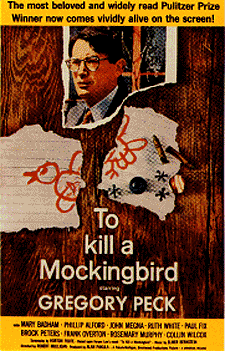
but with themes worthy of their stature, smart adult dramas (On the Water Front, Best Years of Our Lives, Coming Home, Kramer Vs. Kramer,In the Heat of the Night, Crash) that move us while putting a mirror to our society, honest dramas (On Golden Pond, Terms of Endearment, Driving Miss Daisy, Rain Man) that move us with their humanity, comedies (Little Miss Sunshine, Annie Hall) that deal truthfully with real relationships, classics (Casablanca, To Kill a Mockingbird, Schindler's List) with heroes that overcome great adversity to fight for what is right, musicals (Sound of Music, West Side Story, Oliver) that not only entertain but move us with powerful themes, wildly original dramas (Eternal Sunshine of the Spotless Mind, American Beauty) that delight us with their creativity and new perspectives.

Feel free to recommend other inspiring, meaningful Oscar winners for the RI list or comment on the ones below.

Movie Blessings!
Jana Segal
Reel Inspiration

Reel Inspiration recommends: 51 Oscar Winners

51 Oscar winners taken from a list of Best Picture, Best Foreign Language Film, Best Adaptation, and Best Screenplay winners.

Key:
* Won Best Picture
** Won Best Picture and Best Screenplay or Adaptation
BA Best Adaptation
BS Best Screenplay
nom. Nominated
BFL Best
Foreign
Language Film

*1941- How Green Was My Valley, nom. BA: Philip Dunne
1942- BS: Woman of the Year: Michael Kanin, Ring Lardner Jr
**1943- Casablanca - BA: Philip Epstein, Julius J. Epstein, Howard Koch
**1944- BA: Going My Way - Frank Butler, Frank Cavet
**1946- The Best Years of Our Lives - BA: Robert Sherwood
1947- BA- Miracle on 34th Street by George Seaton, nom. Best Picture
**1954- On the Waterfront, BS: Budd Schulberg
**1955- Marty, BA: Paddy Chayefsky
1956- BS: The Red Balloon - Albert Lamorisse
*1959- Ben-Hur, nom BA: Karl Tunberg
*1961- West Side Story, nom BA: Ernest Lehman
*1962- Lawrence of Arabia, nom BA: Robert Bolt, Michael Wilson
1962- BA- To Kill a Mockingbird - Horton Foote, nom. Best Picture
*1964- My Fair Lady, nom. BA: Alan Jay Lerner
*1965-The Sound of Music
**1967- In the Heat of the Night, BA : Stirling Silliphant
*1968- Oliver!, nom. BA: Vernon Harris
**1975 One Flew Over the Cuckoo's Nest, BA: Bo Goldman, Laurence Hauben
**1976- Rocky, BS: Sylvester Stallone
1976-BA- All the President's Men - William Goldman, nom. Best Picture*1977- Annie Hall
1978- BS: Coming Home by Robert C. Jones, Waldo Salt
**1979- Kramer vs. Kramer, BA: Robert Benton
1979- BS- Breaking Away by Steve Tesich, nom. Best Picture
**1981- Chariots of Fire, BS: Colin Welland
1981- BA- On Golden Pond: Ernest Thompson, nom. Best Picture
**1982- Gandhi, BS: John Briley
**1983- Terms of Endearment, BA, James L. Brooks
**1985- Out of Africa, BA: Kurt Luedtke
1985- BS- Witness: William Kelley, Earl Wallace
1986- BA: A Room with a View: Ruth Prawer Jhabvala, nom. Best Picture
1987- BS: Moonstruck: John Patrick Shanley, nom. Best Picture
**1988- Rain Man, BS: Ronald Bass, Barry Morrow
1988-BFL: Cinema Paradiso: Giuseppe Tornatore
**1989- Driving Miss Daisy, BA: Alfred Uhry
1989- BS- Dead Poets' Society: Tom Schulman, nom. Best Picture
*1990- Dances with Wolves
**1993- Schindler's List, BA: Steven Zaillian
1993- BS- The Piano by Jane Campion, nom. Best Picture
**1994- Forrest Gump, BA: Eric Roth
1995- BA - Sense and Sensibility: Emma Thompson
1997-BS-Good Will Hunting by Ben Affleck, Matt Damon, nom. Best Picture
**1999- American Beauty, BS: Alan Ball
*2000-Gladiator, nom. BS: David Franzoni, John Logan, William Nicholson
2000- BA- Almost Famous: Cameron Crowe
**2001- A Beautiful Mind, BA: Akiva Goldsman
2003-BS - Lost in Translation - Sofia Coppola, nom. Best Picture
2004- BS- Eternal Sunshine of the Spotless Mind: Charlie Kaufman
**2005- BS- Crash: Paul Haggis, Bobby Moresco
2005-BFL The Lives of Others, Florian Henckel von Donnersmarckt
2006- BS- Little Miss Sunshine: Michael Arnd, nom. Best Picture

Movie Blessings!

Jana Segal