Showing posts with label Best Picture Oscar Winners. Show all posts

Tuesday, February 02, 2016

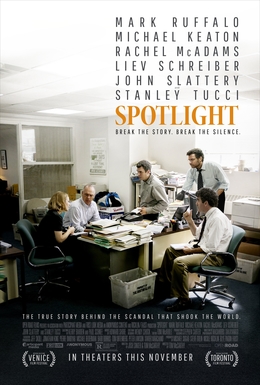
Spotlight in the Dark


“I am here because I care. We are going to tell this story and tell it right.”

Those are the words Spotlight investigative reporter Sacha Pfeiffer (Rachel McAdams) uses to convince an abuse survivor to share his story. That also seems to be the philosophy of the principals involved in the stellar production of “Spotlight.”

From the time the actors (including Mark Ruffalo, Michael Keaton, and Stanley Tucci) read the smart, layered script they knew that it was a special project. They were grateful to be working with colleagues they admired on such an important film, and they did their best to do it justice.

Spotlight” is the true story of how a team of investigative reporters from the Spotlight division of the Boston Globe uncovered a massive scandal of child molestation within the Catholic Archdiocese.

It is a rare picture that moves you without manipulating you with shocking, exploitative images. Writer/director Tom McCarthy and writer Josh Singer tell this story and tell it right – by treating the sensitive material with respect.

The real-life journalists (Editor Walter "Robby" Robinson, and reporters Michael Rezendes, Matt Carroll, and Sacha Pfeiffer) praised the filmmakers for their accurate portrayal of what investigative reporters do and for highlighting why their work is so important. Their Spotlight article gave a voice to the survivors who couldn’t speak up for themselves, and let them know that they weren’t the only victims.

Keeping that dirty secret was literally killing the victims. In the movie, a reporter notices track lines on a survivor’s arm. The survivor’s lawyer explains that he is one of the lucky ones because he is still alive. What made the movie so moving was how the survivors are portrayed as courageous for speaking out. They paid a huge personal price by opening those old wounds. But they did it to save children.

One survivor explained how he fell prey to the priest. “When you’re a poor kid from a poor family, and a priest pays attention to you, it’s a big deal. How do you say no to God?” The violation goes beyond just molestation. It is the breaking of faith that is so devastating - that your neighborhood priest, who represents God, took advantage of you.

But the reporters dug up a bigger story – the church superiors covering it up. The investigation is riveting. The dedicated reporters sift through layer after layer of the cover-ups throughout the institution: the Catholic Dioceses, the neighborhood parishes, and even the families themselves. The bishops had pressured the families not to speak of it, using the excuse that it was just this one case and you don’t want to hurt the church. The more the reporters dug, the more institutions they found that buried the crimes.

The tension rises as the reporters feel the powerful grip of the Catholic Church in Boston - while the threat of continuing abuse starts to hit home. (One of the pedophile priests has been relocated to a reporter’s neighborhood.)

The film reminds us why investigative reporting is so vital in a democratic society: It is crucial that the press be a watchdog to keep those in power in line, to hold powerful institutions and people accountable (including our government). The more power they have, the more temptation there is to abuse it.

“Spotlight” is the kind of movie that really gets you thinking. So I joined a couple of women in the lobby for a post-movie discussion. We pondered how devastating it must have been for faithful Catholics when this story broke – since they find strength in their religion and their church community. It is so troubling that this institution, whose mission is to aid children in need, would abuse that trust and abuse it hundreds of times - for three decades! “The problem isn’t with God, but the institution,” chimed in one of the women. “The institution is run by men and men are flawed.” The other woman remembered when the story came out. Her father, a devout Catholic, said he didn’t want to hear about it. He didn’t want it to shatter his faith in God or become disillusioned with the church. That attitude certainly played into the systemic problem. Everyone turned a blind eye. Everyone buried the story.  “If it takes a whole village to raise a child, it takes a village to abuse one.” That is why the work of investigative reporters is so important and must be upheld.

We are all in the dark, until we see the light. Until someone shines a “Spotlight” on it.

Movie blessings,
Jana Segal-Stormont
www.reelinspiration.blogspot.com


Oscar News: "Spotlight" WON Best Screenplay (Tom McCarthy and Josh Singer), and BEST PICTURE! 

"Spotlight" was also nominated for Best Director (Tom McCarthy), Best Editing, Best Supporting Actor (Mark Ruffalo) and Best Supporting Actress (Rachel McAdams).

Sunday, February 22, 2015

Oscars: Breaking into the Men's Club


OK. I’m gonna put it right out front and center (like Octavia Spencer's prominent seat at the Oscars.) This year there is not one film with a female lead nominated for Best Picture.

The male dominated academy doesn't seem to consider personal female stories of great enough importance to be nominated for Best Picture. They neglected to nominate, “Wild,” the empowering universal story of a woman’s journey for self-forgiveness, while testing herself on a grueling backpacking hike across the Pacific Crest Trail. Yet they nominated, “Whiplash,” the personal story of a young male drummer suffering for his art. “Boyhood,” the favorite to win Best Picture, is a personal story as well. But deserves attention for director Richard Linklater’s audacity in filming over the course of 12 years.

The Academy favors films about the accomplishments of great men – like this year’s inspiring nominees, “The Imitation Game,” and, “The Theory of Everything,” about a mathematician and scientist respectively. But where are women scientists or mathematicians and their world-changing accomplishments?

As a society, we need more biopics about these incredible women. It is important that their accomplishments be recognized. A few examples: Rear Admiral Grace Hopper has a destroyer named after her to honor her accomplishments including inventing the first compiler, and developing the first high level computer language. Rosalind Franklyn was instrumental in discovering the double helix structure of DNA for which her former collaborators Crick and Watson won the noble prize. This is one time I wish I was wrong. But I when I googled, “Women scientists in movies,” I found only lists of fictional scientists in SciFi films. Perusing the Best Actress nominations throughout the history of the Oscars, I found two movies about women scientists: “Madame Curie” (Marie Curie worked with physicist Pierre Curie to discover radium) back in 1943 and “Gorillas in the Mist” about Dian Fossey’s research with Mountain Gorillas in Africa. “Madame Curie,” was nominated for Best Picture, Best Actress (Greer Garson), Best Actor, and Best Cinematography, yet this accomplished biopic didn't win any academy awards. “Gorillas in the Mist,” was nominated for Best Adapted Screenplay and Best Actress (Sigourney Weaver) back in 1988.

Of course, great advancements don’t happen in a bubble. In the 1840s, Ada Lovelace worked on Charles Babbage’s early mechanical general-purpose computer, the Analytical Engine. Her notes on the engine include the first algorithm carried out by the machine. She is often described as the world’s first computer programmer.


Cooperation is one of the themes of, “The Imitation Game.” It took a team sharing their different strengths to break the code of the German Enigma cipher and win the war. It took military strategy, math skills, relationship strengths, and being able to see the whole picture. “Sometimes it is the people who no one imagines anything of who do things that no one can imagine.” Mathematician Alan Turing (Oscar nominated Benedict Cumberbatch) doesn't relate to the world like others do, but it is that difference of perception that allows him to create a machine to crack the enigma. No doubt Turing studied Ada Loveless’ work while at Princeton. That may be how he was able to recognize that Joan Clark’s (Keira Knightley) mathematical strengths would benefit the team. And it is also Joan who taught him to work together with the other team members in order to accomplish their goals.

The “Theory of Everything,” was based on the inspiring story of how Stephen Hawking, (Oscar winner Eddie Redmayne) was empowered and supported by his wife Jane (Oscar nominated Felicity Jones), and postulated the theoretical prediction that black holes emit radiation and researched a unifying theory of relativity and quantum mechanics while suffering from ALS disease that increasingly paralyzed him. While the movie doesn't cover the “Theory of Everything” or even Stephen’s scientific process in any depth, Director James Marsh illuminates the Hawkings' relationship and the world of science with spectacular poetry and wonder.

Now let’s get down to the Oscar snub. “Selma,” one of the best reviewed, most powerful films of the year didn't garner its director, Ava DuVernay, a Best Director nomination. (Read more about this in my previous review.) Like, “The Imitation Game,” it celebrates the accomplishment of a great man. But "Selma," concentrates on the community and collaboration. DuVernay realizes her vision by inviting the audience into the spirit of the Civil Rights movement from the point of view of its black protagonists. The movement (and resulting movie) was bigger than just one man. It was a community working together, and risking their lives, fighting for freedom for generations to come. DuVernay shows women as partners in the cause. Coretta Scott King enabled her husband to be the voice of the movement by supporting him financially while raising their children. Women and men lock arms and march bravely together.

While, "Selma," shows the effectiveness of collaboration and non-violent protest; "American Sniper," glorifies Chris Kyle as an indispensable, one-man killing machine. “American Sniper,” was produced to draw attention to the condition of vets returning from the war. That is certainly a noble purpose. But it is also a masterfully crafted propaganda movie (much like John Wayne's Vietnam War film, “The Green Berets," which wasn't nominated for an Oscar.) In, "American Sniper," there is no question that Chris Kyle was justified in killing every Iraqi because nearly every one of them was shown carrying a weapon. The theme of the movie is black and white. It is us against the evil terrorists. But what would you do if your neighborhood was occupied and soldiers were breaking into your house? I found it very disturbing when I started rooting for Chris to kill the evil terrorists. The film has already had its desired effect, as a Facebook friend commented, “We need to kill everyone of those evil bastards.” To me this is a misuse of the power of film.

I’m not ready to give up on the Oscars yet. The top runners for Best Picture: “Boyhood,”, “Birdman or (the Unexpected Virtue of Ignorance)," and, “The Grand Budapest Hotel,” all deserve their nominations.

It is a miracle that Linklater was able to pull off this unprecedented feat of shooting the same actors over the course of 12 years. No theme is imposed on, “Boyhood,” aside from memories projected over the passage of time. There is no big turning point that inspires the characters’ growth, just living through life’s daily struggles. This accumulates into something very moving over the course of the film and their lives.

Wes Anderson creates intricate details in the whimsical, quirky world of, “The Grand Budapest Hotel,” where the melancholy staff try to maintain bygone civility and loyalty amongst a backdrop of brutality, war and loss. The physical comedy is spot on and the action sequences thrilling and fun!

In Oscar-winning Director Alejandro González Iñárritu's, "Birdman (Or the Unexpected Virtue of Ignorance),” a comic book action star struggles to express himself as an artist, to find some relevance in his life, to prove that his life matters. It is a biting satire on the price of fame and how Hollywood clips the wings of its artists in their pursuit of profits.

All three films deserve their Best Picture nominations for brilliantly realizing their directors’ original visions. I just hope that next year the Academy chooses to empower women filmmakers by nominating them into the club.

Oscar blessings!
Jana Segal
www.reelinspiration.blogspot.com

OSCAR UPDATE:

Patricia Arquette won Best Actress for, "Boyhood" and gave an impassioned plea for equal rights for women in America.

The powerful performance of Best Song winner, "Glory," honoring, "Selma," along with the speeches by songwriters Common and John Legend moved many to tears.

Eddie Redmayne won Best Actor for, "The Theory of Everything."

Graham Moor won Best Adaptation for "The Imitation Game."

Alejandro González Iñárritu won Best Director, Best Picture and Best Original Screenplay (along with Nicolas Giacobone, Alexander Dinelaris Jr. and Armando Bo) for, "Birdman."


Congratulations to all the winners! 

Monday, January 12, 2015

"12 Years a Slave"

Director Steve McQueen with Best Picture Oscar
Best Picture winner, “12 Years a Slave,” is based on the empowering true story of Solomon Northup, an African-American musician and freeman, who is kidnapped and sold into slavery.

There have been many movies about the plight of the slaves. But “12 Years a Slave,” by director Steve McQueen and Oscar award-winning adapter, John Ridley, transcends the others by illuminating the importance of not only surviving, but surviving with dignity. When Solomon (Chiwetu Ejiofor) is first kidnapped, he insists that he is a freeman. In an attempt to break his spirit, his captors beat him within an inch of his life. A fellow captive advises him that if he wants to survive, he must keep a low profile and not let them know he can read and write. The hopelessness of his situation finally sets in as other slaves fail gravely in their attempts to escape. He decides to cooperate, but continues exercising to keep up his strength so he is prepared when the opportunity to escape arises. But he soon observes that cooperation doesn’t save his fellow slaves from abuse. They are considered property and are whipped or killed at their master’s whim.

SPOILER AHEAD:

Solomon finally decides to risk everything to realize himself. He demonstrates his intelligence by engineering a way for logs to be carried across the river. The master is pleased and rewards him with a violin – a show of respect (and a possible way for him to earn money to buy his freedom). The white foreman becomes jealous and attacks him, but now Solomon fights back like a man. Later, the foreman returns to hang him. The master runs the foreman off, but leaves Solomon hanging from the noose barely able to hold up his weight on his tip toes. The master punishes the foreman for messing with his property, and sends a message to Solomon to stay in his place.

The film also examines the lives of the slaves who chose to please their masters. A spirited young slave, Patsey, (Best Actress winner Lupita Nyong’o) captures her master’s attention by cheerfully picking more cotton then the rest of the slaves. He watches her dancing in the slave quarters, entranced, longing to capture her jubilant spirit. When his wife protests, he insists on keeping his slave and suggests that his wife leave if she doesn’t like it. The wife finds little ways to belittle Patsey’s dignity like depriving her of soap. Believing she is entitled to special treatment as the master’s favorite, Patsey goes off to fetch some for herself. Furious at her for trying to escape, the master beats her. She pleads with him - explaining that she was just getting soap and that she has earned the right to keep herself clean. But this angers him even more. Egged on by his wife, he forces Solomon to beat her to demonstrate to both of them that he can do what he wants with his property.

Despite his captors’ best efforts to break his spirit, Solomon Northup never gives up his identity. By exhibiting his strength as a man, he plants a seed of thought – I am a man and no man’s property! By surviving with dignity, he liberates himself and others.

Movie blessings! 
Jana Segal 
www.reelinspiration.blogspot.com

Saturday, March 31, 2012

"The Artist" Reinvents Silent Pictures

O.K. I didn't want to like "The Artist." I've had it up to here with Hollywood remakes. Even Broadway is adapting Hollywood blockbusters for the stage. Is there an original idea out there! At the last Screenwriting Expo, more than one manager insisted that to break into the biz, you should take an old story and put a new twist on it. And to be honest, it worked reasonably well for the Cinderella remake, "Enchanted." (Though the over the top Alladin climax was a mess.)

So I should be morally opposed to, "The Artist," because it puts two old stories together – the over done, "A Star is Born" and "Singing in the Rain." Bigger-than-life movie star George Valentin (Best Actor Oscar winner Jean Dujarin) fades into oblivion with the decline of silent pictures as his young love interest, Peppy Miller, (the lovely Bérénice Bejohe) rises to stardom with the talkies.

French director (Best Director winner) Michel Hazanavicius chose to make a black and white silent picture. I'll admit here that I'm not a big fan of silent movies because I can't stand the fake, theatrical posturing and mugging. But, "The Artist" transcends the limitations of the silent form. Michel reinvents silent pictures by using a naturalistic acting style, exquisite cinematography, and modern storytelling devices such as opening with a silent film within a silent film. But what really makes it stand out are the clever, charming moments. In one touching moment, Peppy snuggles up to Valentin's jacket on the coat rack as if she is embracing the man. The actress is so totally invested in the hug that when Valentin catches her, he flashes a surprised, then amused grin that lights up his whole face. Sigh. Did I mention the incredible chemistry between these two charismatic actors?

A Facebook friend complained that Dujarin won best actor without uttering a word of dialogue. (Did he actually see the film?) But, as they taught us in Film 101, a movie is moving pictures. You should be able to understand the story with the sound turned off. Jean Dujarin, as George Valentin, goes through a full character arch from arrogance to falling in love to hitting rock bottom without the crutch of dialogue. And he kept me engaged in every scene. And he can tap dance! I'd say the Oscar was well deserved.

"The Artist" is more than a homage to the silent film era, it transcends the form. It presents a universal theme: When the old ways no longer work, ego may hinder us from adapting to the new ways, but in the end love conquers all.

It's not hard to see why it won Best Picture. You can see the love in every frame.

Movie blessings!
Jana Segal
www.reelinspiration.blogspot.com

Wednesday, June 01, 2011

“The King's Speech - Better Late than Never or Jana Eats Crow...n"


The King's Speech” begins with the future King of England, Prince Albert, the Duke of York, stammering into the microphone at his first public address. In the next sequence he is further humiliated by a speech therapist who requires the Duke to hold marbles in his mouth while attempting to enunciate. Fast forward. England is now on the verge of the second World War and the newly appointed King George VI must deliver the most important speech of his life.

I'm sorry that it has taken me so long to review this inspiring film. I actually saw it on opening weekend, but had some misgivings that my prevented my complete involvement in what seemed to be an enchanting film. Here's the rub. My head was clouded by stories of how my uncle had overcame his own debilitating stammer - so something about the therapy sessions in the film didn't ring true for me. I brought my uncle with me for my second viewing. He confirmed my doubts about the effectiveness of the therapy. He explained that the cure for his stammering was to become less self-conscious of his speech, and that the speech exercises shown in the film would only succeed in making a stammerer more self-conscious. (We still enjoyed the film - making allowances that this may have been the only therapy available at the time.) At my third viewing, I finally got it. The technical exercises were never intended to correct the stammer. The King, who had previously deemed the technical exercises ridiculous, actually requested them because that was more comfortable than working through his feelings in therapy. The therapist, knowing that the useless exercises would give the determined King something concrete to work on, scheduled daily exercises to create an atmosphere of comfort and confidence that would eventually lead the King to trusting his therapist and himself. Trust was the important factor in uncovering the source of the stammer and facing it.

After my new realization set in, it all made sense. The whole story is built on trust. At their first meeting the Duke tests the therapist. The therapist's first task is to overcome the Duke's resistance by demonstrating his expertise. He insists from the onset that they forgo formal titles such as, “Your Majesty” or “Doctor” because trust can only be built on a foundation of equality. But the Duke refuses, holding steadfast to the trappings of his position as a barrier from dealing with his fears and insecurities. But his frustration with his speech and his deep commitment to his family responsibilities keeps bringing him back. Finally, there is a break-though. The tragedy of his father's death brings up painful memories and the Duke finally opens up about his past. But an even greater fear causes him to retreat again - the possibility that he may become king. He bellows at the top of his lungs that a King's only duty is to speak for the people and he can't bloody speak! When he discovers that his therapist is not officially a doctor, the King hides behind a shield of mistrust accusing his therapist of being a fraud. But, his therapist is right. In order to find his voice, his Majesty must overcome his feeling of unworthiness and trust that he is the leader the country needs. This story is about more than making, “The King's Speech.” It is about the making of a King.

I highly recommend the very worthy Best Picture winner, “The King's Speech,”(better late then never) for it's clever, insightful script by David Seidler, Colin's Firth's dynamic, Oscar winning performance and Geoffrey Rush's hilarious take on the eccentric therapist. (I guess Oscars for Best Director and Best Picture is confirmation enough for director Tom Hooper.)

Movie blessings!
Jana Segal
www.reelinspiration.blogspot.com

More evidence of how wrong I was about the speech therapy.


Thursday, January 01, 2009

MOST INSPIRING FILMS 2008!

Happy New Year, film lovers!

I've heard some reviewers complain that this has been a bad year for film - some of the same reviewers that think a film can't be art unless it's edgy and vile. But if you love films that move and inspire you or films that are true expressions of the filmmaker's artistic vision (even if they make you work for it) - then this was a great year for film!

It is a pleasure to present Reel Inspiration's MOST INSPIRING FILMS 2008. This list is compiled of films that have been promoted through our reviews on Reel Inspiration's blogs. Diverse films with entertaining, powerful stories that uplift, challenge, give hope or inspire. Some weight has been given to films that are particularly relevant to the issues of our time.

I realize that there are many definitions and opinions on what makes up an inspiring film. I would love to hear them! That's why I'm giving you a chance to share your favorite inspiring films in the comment section.

Wishing you many movie blessings in the New Year!
Jana Segal

MOST INSPIRING FILMS 2008

11. Director Mike Leigh is known for using improv to develop his scripts and to get natural dialogue and performances out of his actors. His film, "Happy Go Lucky" goes beyond that. It had me thinking after I left the theater. How many current comedies can you say that about?

10. Charlie Kaufman's film, "Synecdoche, New York," is as challenging as the name. Kaufman literally creates a whole world and realizes his uncompromising (though somewhat depressing) creative vision. Some of the images stayed with me for days and I had real a longing to see it again.

9. The touching film, "Under the Same Moon" puts a human face on the heated debate about illegal immigrants and border issues.

8. "Slumdog Millionaire" was hard for me to sit through - watching all those horrific scenes of Indian slum children being abused. But the highly innovative story builds to a strong ending with the worthy theme of how good triumphs over adversity when you stay on your true path.

6 and 7. Music transcends racial differences and initiates human connections in, "The Visitor" and "The Bands Visit." "The Visitor" also reminds us that kindness is it's own reward - earning it the number 5 spot.

5. "The Secret Life of Bees" is a coming of age story set in the South during the Civil Rights Movement. A runaway white girl learns to cope with the painful truth and find forgiveness through the unconditional love of this uniquely liberated black family. I wanted to stay in the world of this heartwarming film and join the family.

4. In the opening scene, we see through magazine editor Jean-Dominique Bauby’s point of view as he awakens from a comatose state. It is as if we are inside his head, seeing through his one good eye. We experience his confusion and claustrophobia after becoming paralyzed with a rare illness called “locked-in syndrome.” “The Diving Bell and the Butterfly,” is a metaphor for how he is trapped in his body, but his mind soars as it creates glorious scenes which explore imagined experiences. As Bauby recuperates, he dictates a memoir through the blink of his eye with the aid of his nurses.

3. "Frost/Nixon" is based on the famous news special in which English talk show host, Frost, tried to coax a confession out of Nixon for his part in Watergate. This is a particularly timely piece since many Americans can relate the feeling of losing faith in our government. I found myself rooting for this second rate talk show host to convince the intellectually superior Nixon to finally take responsibility for the cover up and hurting the American people. Compelling writing and acting. I wasn't watching actors, I was watching Frost and Nixon.

2. "Starting Out in the Evening." Andrew Wagner's sheer love of writing radiates in this deep and touching adult drama set in the dying literary world. It might be because I'm a writer, but this film lives in my heart.

1. Harvey Milk's life as the first openly gay elected official is inspiring enough. But actor Sean Penn (living the role of Harvey Milk), writer Dustin Lance Black, and director Gus Van Sant elevate "Milk" from a biopic to art.

You can find full reviews of these films below.

ENJOY!

OSCAR UPDATE:

 Sean Penn won Best Actor and Dustin Lance Black won Best Original Screenplay for "Milk."

"Slumdog Millionaire" won Best Picture, Danny Boyle won Best Director, Simon Beaufoy won Best Adapted Screenplay, Anthony Dod Mantle won Best Cinematography, Chirist Dickens won Best Editing for "Slumdog Millionaire." 

Mike Leigh won Best Original Screenplay for, "Happy Go Lucky." 

"Frost/Nixon"


OK. I'm sappy when it comes to our country. I cry when I hear the national anthem. I wept as I watched the airplanes crash into the World Trade Center not only for the lost lives but because I suspected it would result in some loss of our freedom as Americans. And I still have unresolved feelings of anger that our country was misled and polarized by the Bush administration.

There are two biopics in theaters now that deal with presidents who shattered Americans' trust in our government. I believe that biopics can be very powerful when they deal with our unresolved issues. I went to these films to find some kind of understanding and resolution. Unfortunately, the film "W" doesn't begin to deal with my issues with Bush. Oddly, director Oliver Stone seems to make excuses for Bush. No matter what he did, party boy George could never win his daddy's approval. Maybe I'm not there yet, but I have no need to sympathize with the spoiled rich kid portrayed here. This shallow justification was just as unsatisfying as the acting. I was always keenly aware that I was watching an actor (Josh Brolin) playing the President.

"Frost/Nixon" is based on the famous news special in which British talk show host, David Frost (Michael Sheen), tried to coax a confession out of former President Richard Nixon (Frank Langella) for his part in Watergate after he is pardoned by President Ford. Media savvy David risks an insanely huge sum of money for the interview in hopes of getting commercial sponsors and more credibility so he can get back his New York talk show and his table at Sardi's. I found myself rooting for this second rate talk show host to convince the intellectually superior Nixon to finally take responsibility for the cover up and for hurting the American people. I discovered, along with Frost, the importance of uncovering the truth as a much needed resolution. The acting and the writing (Peter Morgan) are thoroughly compelling. I wasn't watching actors, I was watching Frost and Nixon. It was a pleasure watching them in their "no holds barred" debate.

I found "Frost/Nixon" infinitely more satisfying than "W". Director Ron Howard wisely saw America's need for the truth and addressed it. Hmm. Perhaps we could use a "Frost/Bush" interview...

Movie Blessings!
Jana Segal

OSCAR UPDATE

Frost/Nixon Won Best Picture, Frank Langella won Best Actor, Ron Howard won Best Director, Peter Morgan won Best Adapted Screenplay, Mike Hill and Daniel P. Hanley won Best Editing

Monday, December 29, 2008

"Slumdog Millionaire"


by guest reviewer Josh Valentine
Indiebum

Is America ready for Bollywood? With filmmakers like Danny Boyle integrating Bollywood styles with his own terrific, seasoned style in his new film “Slumdog Millionaire,” cultural cinema desegregation is not the final answer in modern filmmaking – it is the beginning of something new. Without a doubt, Boyle’s new work is a masterpiece, proving he is one of our greatest directors of this generation.

“Slumdog Millionaire” is the story of Jamal Malik (Dev Patel), a young man under suspicion after a winning streak on India’s version of “Who Wants to be a Millionaire?” In America that show has become somewhat irrelevant (is it even on anymore?) but for Jamal, the show means everything. Not for the money, but for his one and only love Latika (Frieda Pinto) who he feels he can win by appearing on her favorite program.

We learn that Jamal has lived a very interesting life - one might consider a sometimes dangerous life. But for Jamal this life has taught him the answers he needs to become the man he is destined to become. Coincidentally, those answers are the strangely yet inventively the answers to the questions he is asked on the television program. First-time Boyle collaborator Simon Beaufoy (the Oscar nominated writer of “The Full Monty”) intertwines beautifully the story of Jamal’s fruitful life and the questions on the program to paint the intriguingly poignant story of his main character’s growth. It’s genuinely refreshing to see film narrative portrayed in such an original way, and Beaufoy’s script is simply one of the best this year.

While Beaufoy’s script has not gone unnoticed in critics’ circles, something that may be missed is the strong performance of Dev Patel as Jamal. His portrayal is strikingly profound and at the same time ultimately inspiring. Patel has a wondrous quality in his eyes when he shares scenes with Pinto’s Latika. We can see the yearning and true love of his character – an honest performance by a young man who has the potential for bigger and better things.
This is the second coming-of-age film to impress this year (the first was “The Wackness,” although that film did have a larger amount of detractors), although its crowd pleasing nature is no surprise. With some of the better films of this century under his belt such as “28 Days Later…,” “Millions” and last year’s sci-fi opus “Sunshine,” Boyle has proved himself the forerunner for best director of the past ten years. With “Slumdog Millionaire,” Boyle chose to find yet another film style to re-invent. It’s certainly a stronger film in terms of coming-of-age than “The Wackness” (although Jonathan Levine’s debut was an excellent showing of early nineties indie grit) and affirms that Boyle has the uncanny knack for outshining his colleagues.

This will be Boyle’s second film to be honored by Oscar nominations (his drug film “Trainspotting” was nominated in 1997), most likely in the adapted screenplay and best picture categories, and one can only hope the Academy will enjoy the film as much as audiences. It’s a grand piece for Boyle, who again demonstrates his ability to take something that he loves (film) and illustrate it in new and exciting ways. One of the strongest films of the year, “Slumdog Millionaire” should be at the top of your must-see list.

OSCAR ALERT:

"Slumdog Millionaire" won Best Picture, Danny Boyle won Best Director, Simon Beaufoy won Best Adapted Screenplay, Anthony Dod Mantle won Best Cinematography, Chris Dickens won Best Editing

Wednesday, December 12, 2007

Reel Inspiration recommends: 51 Oscar Winners

At their best, films have the power to inspire, empower, enlighten, uplift, and challenge. Reel Inspiration promotes films at their best! R.I. promotes diverse narrative films with high production values and entertaining, meaningful stories. You know... movies you can watch more than once because they have something to say, movies that reflect the condition of our society, the nature of our relationships or the issues of our times - movies that move us.

I've compiled a list of 51 Oscar winners that I feel fit Reel Inspiration's criteria for promotion. The films are taken from the list of Best Picture, Best Adaptation, Best Screenplay, and
Best Foreign Language Film Oscar winners. You may notice that a majority of the Best Picture winners also won best screenplay or adaptation (or were nominated for these awards.) I believe that what made these films winners is that they had important themes -- that comes from great writing. So I've included the screenwriters when they won in their category.

Included on my list are: classic epic films (Ben Hur, Lawrence of Arabia, Gladiator, Gandhi) that not only inspire us with their grandeur
but with themes worthy of their stature, smart adult dramas (On the Water Front, Best Years of Our Lives, Coming Home, Kramer Vs. Kramer,In the Heat of the Night, Crash) that move us while putting a mirror to our society, honest dramas (On Golden Pond, Terms of Endearment, Driving Miss Daisy, Rain Man) that move us with their humanity, comedies (Little Miss Sunshine, Annie Hall) that deal truthfully with real relationships, classics (Casablanca, To Kill a Mockingbird, Schindler's List) with heroes that overcome great adversity to fight for what is right, musicals (Sound of Music, West Side Story, Oliver) that not only entertain but move us with powerful themes, wildly original dramas (Eternal Sunshine of the Spotless Mind, American Beauty) that delight us with their creativity and new perspectives.

Feel free to recommend other inspiring, meaningful Oscar winners for the RI list or comment on the ones below.

Movie Blessings!
Jana Segal
Reel Inspiration

Reel Inspiration recommends: 51 Oscar Winners

51 Oscar winners taken from a list of Best Picture, Best Foreign Language Film, Best Adaptation, and Best Screenplay winners.

Key:
* Won Best Picture
** Won Best Picture and Best Screenplay or Adaptation
BA Best Adaptation
BS Best Screenplay
nom. Nominated
BFL Best
Foreign
Language Film

*1941- How Green Was My Valley, nom. BA: Philip Dunne
1942- BS: Woman of the Year: Michael Kanin, Ring Lardner Jr
**1943- Casablanca - BA: Philip Epstein, Julius J. Epstein, Howard Koch
**1944- BA: Going My Way - Frank Butler, Frank Cavet
**1946- The Best Years of Our Lives - BA: Robert Sherwood
1947- BA- Miracle on 34th Street by George Seaton, nom. Best Picture
**1954- On the Waterfront, BS: Budd Schulberg
**1955- Marty, BA: Paddy Chayefsky
1956- BS: The Red Balloon - Albert Lamorisse
*1959- Ben-Hur, nom BA: Karl Tunberg
*1961- West Side Story, nom BA: Ernest Lehman
*1962- Lawrence of Arabia, nom BA: Robert Bolt, Michael Wilson
1962- BA- To Kill a Mockingbird - Horton Foote, nom. Best Picture
*1964- My Fair Lady, nom. BA: Alan Jay Lerner
*1965-The Sound of Music
**1967- In the Heat of the Night, BA : Stirling Silliphant
*1968- Oliver!, nom. BA: Vernon Harris
**1975 One Flew Over the Cuckoo's Nest, BA: Bo Goldman, Laurence Hauben
**1976- Rocky, BS: Sylvester Stallone
1976-BA- All the President's Men - William Goldman, nom. Best Picture*1977- Annie Hall
1978- BS: Coming Home by Robert C. Jones, Waldo Salt
**1979- Kramer vs. Kramer, BA: Robert Benton
1979- BS- Breaking Away by Steve Tesich, nom. Best Picture
**1981- Chariots of Fire, BS: Colin Welland
1981- BA- On Golden Pond: Ernest Thompson, nom. Best Picture
**1982- Gandhi, BS: John Briley
**1983- Terms of Endearment, BA, James L. Brooks
**1985- Out of Africa, BA: Kurt Luedtke
1985- BS- Witness: William Kelley, Earl Wallace
1986- BA: A Room with a View: Ruth Prawer Jhabvala, nom. Best Picture
1987- BS: Moonstruck: John Patrick Shanley, nom. Best Picture
**1988- Rain Man, BS: Ronald Bass, Barry Morrow
1988-BFL: Cinema Paradiso: Giuseppe Tornatore
**1989- Driving Miss Daisy, BA: Alfred Uhry
1989- BS- Dead Poets' Society: Tom Schulman, nom. Best Picture
*1990- Dances with Wolves
**1993- Schindler's List, BA: Steven Zaillian
1993- BS- The Piano by Jane Campion, nom. Best Picture
**1994- Forrest Gump, BA: Eric Roth
1995- BA - Sense and Sensibility: Emma Thompson
1997-BS-Good Will Hunting by Ben Affleck, Matt Damon, nom. Best Picture
**1999- American Beauty, BS: Alan Ball
*2000-Gladiator, nom. BS: David Franzoni, John Logan, William Nicholson
2000- BA- Almost Famous: Cameron Crowe
**2001- A Beautiful Mind, BA: Akiva Goldsman
2003-BS - Lost in Translation - Sofia Coppola, nom. Best Picture
2004- BS- Eternal Sunshine of the Spotless Mind: Charlie Kaufman
**2005- BS- Crash: Paul Haggis, Bobby Moresco
2005-BFL The Lives of Others, Florian Henckel von Donnersmarckt
2006- BS- Little Miss Sunshine: Michael Arnd, nom. Best Picture

Movie Blessings!

Jana Segal