Showing posts with label Best Screenplay Oscar Winners. Show all posts

Tuesday, February 02, 2016

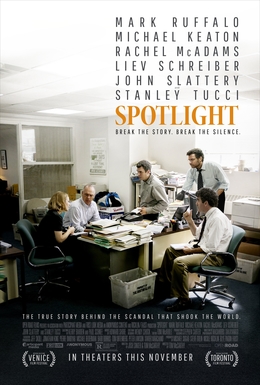
Spotlight in the Dark


“I am here because I care. We are going to tell this story and tell it right.”

Those are the words Spotlight investigative reporter Sacha Pfeiffer (Rachel McAdams) uses to convince an abuse survivor to share his story. That also seems to be the philosophy of the principals involved in the stellar production of “Spotlight.”

From the time the actors (including Mark Ruffalo, Michael Keaton, and Stanley Tucci) read the smart, layered script they knew that it was a special project. They were grateful to be working with colleagues they admired on such an important film, and they did their best to do it justice.

Spotlight” is the true story of how a team of investigative reporters from the Spotlight division of the Boston Globe uncovered a massive scandal of child molestation within the Catholic Archdiocese.

It is a rare picture that moves you without manipulating you with shocking, exploitative images. Writer/director Tom McCarthy and writer Josh Singer tell this story and tell it right – by treating the sensitive material with respect.

The real-life journalists (Editor Walter "Robby" Robinson, and reporters Michael Rezendes, Matt Carroll, and Sacha Pfeiffer) praised the filmmakers for their accurate portrayal of what investigative reporters do and for highlighting why their work is so important. Their Spotlight article gave a voice to the survivors who couldn’t speak up for themselves, and let them know that they weren’t the only victims.

Keeping that dirty secret was literally killing the victims. In the movie, a reporter notices track lines on a survivor’s arm. The survivor’s lawyer explains that he is one of the lucky ones because he is still alive. What made the movie so moving was how the survivors are portrayed as courageous for speaking out. They paid a huge personal price by opening those old wounds. But they did it to save children.

One survivor explained how he fell prey to the priest. “When you’re a poor kid from a poor family, and a priest pays attention to you, it’s a big deal. How do you say no to God?” The violation goes beyond just molestation. It is the breaking of faith that is so devastating - that your neighborhood priest, who represents God, took advantage of you.

But the reporters dug up a bigger story – the church superiors covering it up. The investigation is riveting. The dedicated reporters sift through layer after layer of the cover-ups throughout the institution: the Catholic Dioceses, the neighborhood parishes, and even the families themselves. The bishops had pressured the families not to speak of it, using the excuse that it was just this one case and you don’t want to hurt the church. The more the reporters dug, the more institutions they found that buried the crimes.

The tension rises as the reporters feel the powerful grip of the Catholic Church in Boston - while the threat of continuing abuse starts to hit home. (One of the pedophile priests has been relocated to a reporter’s neighborhood.)

The film reminds us why investigative reporting is so vital in a democratic society: It is crucial that the press be a watchdog to keep those in power in line, to hold powerful institutions and people accountable (including our government). The more power they have, the more temptation there is to abuse it.

“Spotlight” is the kind of movie that really gets you thinking. So I joined a couple of women in the lobby for a post-movie discussion. We pondered how devastating it must have been for faithful Catholics when this story broke – since they find strength in their religion and their church community. It is so troubling that this institution, whose mission is to aid children in need, would abuse that trust and abuse it hundreds of times - for three decades! “The problem isn’t with God, but the institution,” chimed in one of the women. “The institution is run by men and men are flawed.” The other woman remembered when the story came out. Her father, a devout Catholic, said he didn’t want to hear about it. He didn’t want it to shatter his faith in God or become disillusioned with the church. That attitude certainly played into the systemic problem. Everyone turned a blind eye. Everyone buried the story.  “If it takes a whole village to raise a child, it takes a village to abuse one.” That is why the work of investigative reporters is so important and must be upheld.

We are all in the dark, until we see the light. Until someone shines a “Spotlight” on it.

Movie blessings,
Jana Segal-Stormont
www.reelinspiration.blogspot.com


Oscar News: "Spotlight" WON Best Screenplay (Tom McCarthy and Josh Singer), and BEST PICTURE! 

"Spotlight" was also nominated for Best Director (Tom McCarthy), Best Editing, Best Supporting Actor (Mark Ruffalo) and Best Supporting Actress (Rachel McAdams).

Sunday, April 01, 2012

Jana's Guilty Pleasure - "Midnight in Paris"


"Midnight in Paris" is Woody Allen's love letter to Paris. For me it's total wish full-filling escapism. I can watch it over and over just to be in Paris during artistic Renaissance of the 20s and hang out with the visionary artists of the time. It is the story of Gil, a Hollywood screenwriter, (Owen Wilson in the Woody Allen role) who joins his fiancee (Rachel McAdams) and her family on a business trip to Paris. Being in the "City of Lights" rekindles his dream of living in Paris while he writes his novel. Unfortunately, his fiancee and her parents have more lucrative plans for him. In an effort to escape the ensuing conflict, Gil takes a midnight walk and ends up in 1920's Paris. This is a dream come true for the aspiring novelist as he mingles with great artists (Picasso!) and his literary idols including Hemingway himself! His heroes become his peers and even give him advice as he pursues the enchanting young model who eventually becomes his muse.

It is unusual for such a lite-weight romantic comedy to win an Oscar for Best Original screenplay. But, "Midnight in Paris," is highly original.  The action shifts effortlessly back and forth between two time periods. That takes real writing chops. At least Allen has placed his alter ego in a fresh new setting.  In fact, this is one of the most enjoyable Woody Allen films to come out in years.

Have you ever had the feeling that you were stepping back in time as you strolled down a narrow cobble stone street or visited the old haunts of a favorite writer? Then, "Midnight in Paris," should delight the romantic in you and maybe even inspire you to follow your true passion.

Movie Blessings!
Jana Segal
www.reelinspiration.blogspot.com


Wednesday, March 28, 2012

"The Descendants"


There are times in our lives when our world comes crashing down and we are completely unprepared. Shocked and clueless, we grope around making awkward attempts to deal with the overwhelming situation or to just get by. Like the day my whole life was thrown out of whack when my husband of 23 years announced he wanted a divorce and moved out that afternoon. I did my share of groping to find my footing - not always handling it with the best of grace.

I guess that's why I relate to Alexander Payne's, “The Descendants.” Payne (and Oscar winning co-writers Nat Faxon and Jim Rash) aren't afraid to present a flawed main character, Matt King (George Clooney), who is absolutely clueless about how to handle the life shattering situation he finds himself in when his wife ends up in a coma as the result of a boating accident. To add insult to injury, he discovers that she was cheating on him at the time. It's a one-two punch that leaves him stunned and reeling.

Matt lives in Hawaii, in paradise, but has been so caught up in business transactions that he can't take in the beauty around him. His time has been spent negotiating deals with vacation resorts and condos to sell the pristine forest entrusted to him and the other descendants. This piece of land represents all that he has lost in his life. There was a time that he took his family on regular camping trips there. But he has lost his connection with the land and his family. He has become an absentee husband and father. In fact, he is absent from his own life.

Sometimes it takes a catastrophic event to shake us awake after sleep walking through life. (It took my husband leaving me...) Having been JOLTED awake, Matt is ill equipped to deal with the fall out from the accident on his two troubled daughters. George Clooney brings out the humor as his character gropes around trying to make some sense of the whole mess. When he hears that his wife was cheating, Matt, still in shock, charges off in his clumsy flip flops around a ridiculous circular drive – in search of answers, anything... Later, we can see the inner turmoil in his eyes even as his daughter splashes in the ocean and life goes on around him. Once he has dealt with his own issues, he is better equipped to help others cope with the tragedy. Finally fully awake, Matt sees that he is a part of something bigger than himself. He realizes his responsibility to the land, himself, and those around him. Procuring his place in the world puts his problems in perspective.

As for me, I'm grateful to be awake and learning life's lessons.

Movie blessings!
Jana Segal
www.reelinspiration.blogspot.com

Wednesday, December 17, 2008

"MILK"


In the 1970's, a time when San Francisco cops routinely and viciously attacked men in gay bars, Harvey Milk united the gay community to make a stand for their rights. Amazingly, Harvey became the first openly gay man to be elected to public office where he led the fight to put a stop to a law to have openly gay teachers fired. A woman in a newsreel said, "How can you expect your own rights to be protected if you won't protect those of others?" In the light of the recent election, this message seems especially relevant - and sad. I understand that many Christian blacks coming out for Obama voted against partners' rights in same sex marriages. It just breaks my heart that one persecuted minority would deny the rights of another.

The movie, "MILK" begins with Harvey making a recording, "If you're listening to this, I've been assassinated." In the recording, he attempts to explain his life and motivations. The recordings also act as a structural device effortlessly interweaving the recorded narration with narrative scenes and news footage of the time.

The story opens with gay New Yorker Harvey Milk still in the closet and lamenting about turning 40 without having done anything with his life. He finds his cause when he moves to the Castro neighborhood in San Francisco and becomes the uniting force in the Gay Rights movement. He organizes a ban on neighborhood businesses that mistreat gays and is instrumental in making the Castro a Mecca for gay men. The cause eventually leads him to running for public office.
Harvey explains that he is not running for office - the cause is. The important thing isn't winning, it's building an awareness of gay rights and encouraging gays to come out. And he succeeds at losing two elections before being elected to the Board of Supervisors in 1977.

Harvey is portrayed (Oscar winner Sean Penn lives and breaths the role) as a passionate man both in his relationships and for his cause. He uses a disarming sense of humor to put skeptical straights at ease. He successfully plays the game of politics. The campaign does take a toll on his relationships. Yet Harvey persists in having relationships with needy men. He has a strong need to save those wounded by society and to never to be trapped alone in the closet again.


I brought my twelve-year-old son to show him that the important thing isn't just winning, it's fighting for something important. This movie certainly demonstrated that. Harvey Milk inspired Screenwriter Dustin Lance in his own life - so much that he fought to bring this honest portrayal to the screen.


Movie blessings!
Jana Segal

www.reelinspiration.blogspot.com

OSCAR UPDATE:

 Sean Penn won Best Actor and Dustin Lance Black won Best Original Screenplay for "Milk."

Wednesday, December 12, 2007

Reel Inspiration recommends: 51 Oscar Winners

At their best, films have the power to inspire, empower, enlighten, uplift, and challenge. Reel Inspiration promotes films at their best! R.I. promotes diverse narrative films with high production values and entertaining, meaningful stories. You know... movies you can watch more than once because they have something to say, movies that reflect the condition of our society, the nature of our relationships or the issues of our times - movies that move us.

I've compiled a list of 51 Oscar winners that I feel fit Reel Inspiration's criteria for promotion. The films are taken from the list of Best Picture, Best Adaptation, Best Screenplay, and
Best Foreign Language Film Oscar winners. You may notice that a majority of the Best Picture winners also won best screenplay or adaptation (or were nominated for these awards.) I believe that what made these films winners is that they had important themes -- that comes from great writing. So I've included the screenwriters when they won in their category.

Included on my list are: classic epic films (Ben Hur, Lawrence of Arabia, Gladiator, Gandhi) that not only inspire us with their grandeur
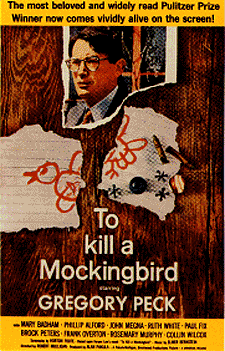
but with themes worthy of their stature, smart adult dramas (On the Water Front, Best Years of Our Lives, Coming Home, Kramer Vs. Kramer,In the Heat of the Night, Crash) that move us while putting a mirror to our society, honest dramas (On Golden Pond, Terms of Endearment, Driving Miss Daisy, Rain Man) that move us with their humanity, comedies (Little Miss Sunshine, Annie Hall) that deal truthfully with real relationships, classics (Casablanca, To Kill a Mockingbird, Schindler's List) with heroes that overcome great adversity to fight for what is right, musicals (Sound of Music, West Side Story, Oliver) that not only entertain but move us with powerful themes, wildly original dramas (Eternal Sunshine of the Spotless Mind, American Beauty) that delight us with their creativity and new perspectives.

Feel free to recommend other inspiring, meaningful Oscar winners for the RI list or comment on the ones below.

Movie Blessings!
Jana Segal
Reel Inspiration

Reel Inspiration recommends: 51 Oscar Winners

51 Oscar winners taken from a list of Best Picture, Best Foreign Language Film, Best Adaptation, and Best Screenplay winners.

Key:
* Won Best Picture
** Won Best Picture and Best Screenplay or Adaptation
BA Best Adaptation
BS Best Screenplay
nom. Nominated
BFL Best
Foreign
Language Film

*1941- How Green Was My Valley, nom. BA: Philip Dunne
1942- BS: Woman of the Year: Michael Kanin, Ring Lardner Jr
**1943- Casablanca - BA: Philip Epstein, Julius J. Epstein, Howard Koch
**1944- BA: Going My Way - Frank Butler, Frank Cavet
**1946- The Best Years of Our Lives - BA: Robert Sherwood
1947- BA- Miracle on 34th Street by George Seaton, nom. Best Picture
**1954- On the Waterfront, BS: Budd Schulberg
**1955- Marty, BA: Paddy Chayefsky
1956- BS: The Red Balloon - Albert Lamorisse
*1959- Ben-Hur, nom BA: Karl Tunberg
*1961- West Side Story, nom BA: Ernest Lehman
*1962- Lawrence of Arabia, nom BA: Robert Bolt, Michael Wilson
1962- BA- To Kill a Mockingbird - Horton Foote, nom. Best Picture
*1964- My Fair Lady, nom. BA: Alan Jay Lerner
*1965-The Sound of Music
**1967- In the Heat of the Night, BA : Stirling Silliphant
*1968- Oliver!, nom. BA: Vernon Harris
**1975 One Flew Over the Cuckoo's Nest, BA: Bo Goldman, Laurence Hauben
**1976- Rocky, BS: Sylvester Stallone
1976-BA- All the President's Men - William Goldman, nom. Best Picture*1977- Annie Hall
1978- BS: Coming Home by Robert C. Jones, Waldo Salt
**1979- Kramer vs. Kramer, BA: Robert Benton
1979- BS- Breaking Away by Steve Tesich, nom. Best Picture
**1981- Chariots of Fire, BS: Colin Welland
1981- BA- On Golden Pond: Ernest Thompson, nom. Best Picture
**1982- Gandhi, BS: John Briley
**1983- Terms of Endearment, BA, James L. Brooks
**1985- Out of Africa, BA: Kurt Luedtke
1985- BS- Witness: William Kelley, Earl Wallace
1986- BA: A Room with a View: Ruth Prawer Jhabvala, nom. Best Picture
1987- BS: Moonstruck: John Patrick Shanley, nom. Best Picture
**1988- Rain Man, BS: Ronald Bass, Barry Morrow
1988-BFL: Cinema Paradiso: Giuseppe Tornatore
**1989- Driving Miss Daisy, BA: Alfred Uhry
1989- BS- Dead Poets' Society: Tom Schulman, nom. Best Picture
*1990- Dances with Wolves
**1993- Schindler's List, BA: Steven Zaillian
1993- BS- The Piano by Jane Campion, nom. Best Picture
**1994- Forrest Gump, BA: Eric Roth
1995- BA - Sense and Sensibility: Emma Thompson
1997-BS-Good Will Hunting by Ben Affleck, Matt Damon, nom. Best Picture
**1999- American Beauty, BS: Alan Ball
*2000-Gladiator, nom. BS: David Franzoni, John Logan, William Nicholson
2000- BA- Almost Famous: Cameron Crowe
**2001- A Beautiful Mind, BA: Akiva Goldsman
2003-BS - Lost in Translation - Sofia Coppola, nom. Best Picture
2004- BS- Eternal Sunshine of the Spotless Mind: Charlie Kaufman
**2005- BS- Crash: Paul Haggis, Bobby Moresco
2005-BFL The Lives of Others, Florian Henckel von Donnersmarckt
2006- BS- Little Miss Sunshine: Michael Arnd, nom. Best Picture

Movie Blessings!

Jana Segal

Tuesday, December 04, 2007

"Juno"


by guest reviewer Gary Ray
One Liner Review

If you’ve seen the trailer for Juno and decided that it’s
not for you, please read on: I’d like to change your mind.
I thought the same thing when I saw the trailer: here we
go again, another “quirky” movie peopled with characters
who’d never do or say half the things they door say and
with a lead character that spouts smart-alecky remarks
that no one could possibly dream up that didn’t have a
week to ponder them.
Then I saw the movie.  Arms folded.  Third row.  In
the first several scenes, my worst fears had come
true— yes, the film was exactly like the trailer.
Then, bit by bit, scene by scene, the story began to
surprise me.  My arms unfolded.  I relaxed. I laughed.
The characters were real.  And the acting— superb.
I know that lead Ellen Page is getting the lion’s share
of the praise (she was the only one nominated for an
Independent Spirit Award), but the rest of the ensemble
possibly give stronger performances than she does.
Michael Cera is astonishingly natural (and understatedly
funny). And one thing I love about the screenplay is
the relationship between him and his baby-mama Juno:
they’re just friends.  They had sex once.  But the script
doesn’t dwell on any “what are we gonna do!” madness.
And then there are Juno’s parents played by Allison
Janney (The West Wing)and J. K. Simmons (he plays Peter
Parker’s editor at the newspaper in the Spiderman movies)
who give stellar performances. And, finally— if I can
think of another superlative—there is Jennifer Garner and
Jason Bateman, who steal the show: both magnificent. It’s
the Garner storyline in particular that, in the final
analysis, won me over on Juno.

As with all great movies, it’s not just the beating of
one single note: but an array of subplots and minor
characters whose lives are affected by the lead
character’s trajectory that make for an ideal movie
experience.  We see how Juno is affecting so many
people’s lives. And, in her separate relationships
with the Garner and Bateman characters, we see an
evolution in her understanding of human nature. And
again, how many movies about teen pregnancy do you know
that aren’t about what a big, dumb mistake it is.
Juno is practically matter-of-fact about the pregnancy
itself. Instead it’s about the world we live in.  Its
about how less screwed up Juno is in light of how more
screwed up the adults are around her. And it’s about
how everything can be okay, no matter how bleak the
outlook.
OSCAR UPDATE: Juno was nominated for Best Picture, Best Directing, Best Actress and Best Screenplay. Diablo Cody won a well deserved Best Screenplay Oscar for her witty and honest writing in Juno. She gave a moving acceptance speech thanking her amazing director (Jason Reitman), lead actress (Ellen Page), and her mom for "accepting me just the way I am."