Showing posts with label Oscars. Show all posts

Sunday, February 21, 2016

In Honor of Women's History Month: Independent Film Arizona presents: "Women in Film"


Join us as five of Tucson's own female directors share their visions and adventures in film-making.


Date: March 1, 2016
Time: 7 p.m
Place: Connect Co-working, 33 South 5th Avenue, Tucson, AZ.


There will be a pre-recorded opening statement by Courtney Marsh, director of "Chau: Beyond the Lines" 2016 Oscar Nominated Documentary Short.


DIRECTORS' BIOS

After writing two books about her life as a professional figure skater and cyclist, Kathryn Bertine worked as a journalist at ESPN and served as the Senior Editor for espnW. She produced, wrote and directed, “Half the Road” about women cyclists. As an advocate for equality in women’s sports, Kathryn started a movement to bring parity to women’s professional road cycling, starting with the Tour de France.


Heather Hale directed two pilots, lots of commercials, and the feature thriller "Absolute Killers" with Edward Furlong (Terminator), Ed Asner and Meat Loaf. She wrote the Lifetime Original Movie “The Courage to Love” starring Vanessa Williams and Stacey Keach.


Anne Dalton provided photography and writing for AZ Public Media. She produced her first documentary, “The Price of Silence,” creating awareness on the rising trend of domestic minor sex trafficking in SAZ. She continues to focus her documentary work on health topics. She mentors others by facilitating the IFA documentary group and workshops. 


Frances Causey acted as national editor and producer for CNN. The team won Emmys for their coverage of the Oklahoma City and Olympic Park Bombings. Frances' documentary, "Heist: Who Stole the American Dream?” was a New York Times Critic’s Pick, distributed in over 50 countries. Frances was honored with the Women's International Film and Television Jury Award for that effort. Frances has become an environmental advocate by presenting, "Ours Is the Land," her short doc about the proposed Rosemont open pit copper mine south of Tucson encroaching on the Tohono O'odham ancestral burial grounds. 


Sarah Sher is a classically trained film and television professional whose disciplines are in writing, directing, and editing. She wrote, produced and directed, "Have Coffin Will Travel" (Reel Inspiration Short Film Contest winner.)  Sarah co-wrote and co-directed (with Dick Fisher), “Stardust and the Bandit.” It won Best TV Pilot at the California Film Awards. With some spare time and good friends she created "The Pet Friendly Traveler," which is due to begin airing on American Public Television in 2017.


Moderator: Jana Segal-Stormont is an award-winning screenwriter, who produced and directed her short scripts, “The Bath-a-holic” and, “Desert Angel.” As the founder of Reel Inspiration, Jana organized the Reel Vision Filmmakers Conference and several directing workshops. For the last 10 years, she has written reviews promoting diverse films with substance. After discovering that less than 7% of studio productions were directed by women, Jana did some research to find out what happened to all the women filmmakers. That resulted in the article “Incredible Invisible Women Filmmakers” and this forum. 


Movie blessings, 
Jana Segal-Stormont

Monday, February 08, 2016

Reflecting on Marriage After "45 Years"

45 Years,” by writer/director Andrew Haigh, opens with a woman walking her dog in her scenic rural neighborhood. The beautiful foliage and lovely silences beckon us to reminisce with the characters in the autumn of their lives.

As Kate (Best Actress nominee Charlotte Rampling) and Geoff Mercer’s 45th anniversary approaches, Geoff (Tom Courtenay) receives a letter that brings to mind a mysterious old flame. “I told you about Katia, didn’t I?” With that, he invites a haunting presence into their seemingly contented lives.

This masterful filmmaking expresses volumes with subtle strokes. Delicate nuances show the familiarity of a long, happy marriage. Kate’s gentle countenance affirms how well she knows and accepts this man, her chosen partner in life. 

A sense of loss is represented by the absence of photographs of the longtime married couple. Why have they neglected to record their history in pictures? Is it because they were always present so there was no need; or is it because their shared moments weren’t significant enough to record in pictures?

Kate’s inner turmoil is subtly conveyed as she finalizes arrangements for a place to celebrate their life together. The event coordinator muses on how the hall is perfect for an important anniversary, because it has lots of history, “like a happy marriage.”

As Geoff becomes distracted and takes up smoking again, Kate is forced to reexamine her marriage. How well does she really know this man? Is their whole marriage a lie? In the darkened theater, we ruminate on the questions of a longtime marriage. How well can you really know your partner? How much do you want to know about your spouse’s private thoughts? How much can you handle?

Kate becomes increasingly concerned as Geoff’s thoughts drift farther away. Instead of reminiscing on their lives together, he seems to be pondering a life never lived with a lover whose beauty is frozen in time.

Kate is awakened in the night by the sound of her husband digging around in the attic. The threat to their marriage is experienced viscerally in a later scene where she struggles with the attic ladder, their dog anxiously whimpering and barking at her feet.

Roman broads in Norfolk
Kate has time to ponder her life’s choices on a ferry ride through the watery byways of the Roman broads. (The waterways created by the Romans digging for peat in England.) A barely audible tour guide states how the broads would not be there if the Romans had chosen to go elsewhere. 

As the day of the party approaches, Kate tells Geoff in no uncertain terms that he has a choice to make. They share a walk on the nature trail and are reminded of his love of birdwatching. She reflects, “It’s funny how we forget the things in life that made us happy.” Indeed, his photography equipment has long been packed away with his old photos in the attic.

Writing this review has been a joy because it inspired me to reflect deeper on the images and their true meanings (even more than I have chosen to relay here.) There are emotional landmines concealed in the autumn woods, waiting to be uncovered.

Movie blessings!
Jana Segal-Stormont
www.reelinspiration.blogspot.com 

Thursday, February 04, 2016

Mad Max: Fury Road - Patriarchal Dystopia

“My name is Max. My whole world is fire and blood. I am the one who runs away from the living and the dead. A man reduced to a single instinct – survive.” Pretty much your average guy.

Mad Max: Fury Road” is the ultimate action flick - a total adrenaline rush of continual action, one long explosive car chase. It is a practical effect picture. Everything you see on the screen is real. Real people driving those trucks, real trucks rolling over and crashing in the Libyan desert. Charlize Theron and Tom Hardy did most of their own stunts. The production had military advisers for the battles.


This is a man’s world. A world out of balance. A world where aggressive masculine traits have overshadowed maternal traits such as responsibility, nurturing, and caring. The result is chaos. The Earth’s resources have been destroyed. It has become a wasteland.

Max (Tom Hardy) is captured by slaves - pawns of the powerful warlords. They drag him, kicking and screaming, to the citadel where he becomes the lowest of all of the slaves. He is used as a blood bag for the half-lives - the slaves who don’t have long to live. They are only kept alive long enough to sacrifice themselves in battle.

The citadel seems to hold the only source of water. The one who controls the water, controls the people. And Warlord Immortan Joe (Hugh Keays-Byrn) controls the water.


“It is by my hand that you will rise up from the ashes of this world.” With a flourish, he releases the water to the desperate citizens.

Imperator Furiosa (bad-ass Charlize Theron), a seasoned warrior entrusted with the water truck, escapes with Immortan Joe’s pregnant “wives” (ie. his best breeders). When Joe searches the compound for them, the nursemaid taunts him, “You cannot own human beings. Eventually they push back.”

“I want them back!” Immortan Joe bellows. “They are my property!”

In this patriarchal world, the women are men’s property, kept as sexual objects and breeders. Their chastity belts are a symbol of how men control women’s bodies, sexuality and reproductive rights. Even mother’s milk is extracted, not to nourish infants, but as a product to be sold for profit.

The breeders are a metaphor for the feminine side of humanity. They have witnessed man’s atrocities. They see how old men enslave young men and throw them away as the fodder of war. “Our babies will not be warriors!” they proclaim. “We’re going to the green place of the many mothers.” They fight for a future for their children.


A half-life war boy named Nux (Nicholas Hoult) attaches Max to the hood of his dune buggy as his blood bag. “If I’m gonna die, I’m gonna die a hero on Fury Road!” he cries. Immortan Joe uses religion to control the slaves. The promise of the after-life inspires his slaves to sacrifice their lives to his will. Nux proclaims that it is his destiny to return the breeders to the almighty Immortan Joe.

An accident frees Max from the front of the buggy. Max, only concerned with his own survival, carjacks the women’s ride.

Nux is persistent in his pursuit. “I am the man who grabs the sun while flying to Valhalla! I live, I die, I live again.” The women are even protective of Nux. When he is captured, they don’t let Max kill him. “He is just a boy.” Perhaps it’s their maternal side; perhaps they relate to him as a fellow slave. Nux tries to convince them to return to Immortan Joe by preaching his word. “By his hands he’ll lift us up.” One of the wives replies, “You’re an old man’s battle fodder. He killed everyone and everything.” “He’s not to blame.” “Then who killed the world?”

Through the women’s courageous example of compassion and hope, both Nux and Max grow. Max goes from animalistic survival instincts (only out for himself) to fighting to protect the future of humanity alongside the matriarchs.

Right now there is an imbalance in our patriarchal country. We have forgotten to protect and uphold our feminine side, our responsibility for our children and our home. “Mad Max: Fury Road” shows what happens when masculine aggression isn’t tempered with responsibility and caring. The worst masculine characteristics are given free rein to destroy, fight, conquer, exploit, enslave, and rape.

It took over 15 years for “Mad Max: Fury Road” to come to fruition, which may have been a blessing since the themes are so timely and relevant to our issues today. This dystopian vision may seem outrageous, but our planet is currently being devastated by our single-minded pursuit of profit at all cost.


This year, Arizona representatives snuck a last minute rider into a must-pass military budget bill to allow a national park (protected by law) to be mined by a foreign company. Extracting the minerals will use too much of our diminishing ground water supply. And mining companies leave behind poisonous tailings that leak into our rivers and lakes. To make matters worse, our representatives are currently fighting to allow mining in all of our National Parks.

As climate change reaches a dangerous tipping point, our Congress voted to decrease environmental protections such as the amount of emissions allowed from coal refineries. They continue to subsidize profitable oil companies who pollute our air and water.

In March, 47 Republicans tried to sabotage peace talks with Iran so a select few could continue to profit from our multi-billion dollar military complex. Our young men are cannon fodder for old men who profit from war.

It is inspiring how some big action directors are making an effort to counteract some of our negative, fear based programming. For instance, “The Hunger Games” demonstrated how the government uses fear and the media to control us. Visionary filmmakers, like "Mad Max: Fury Road" director George Miller, are using the subtext to illuminate important issues of our time.

Movie blessings,
Jana Segal-Stormont 
www.reelinspiration.blogspot.com

Oscar News: "Mad Max: Fury Road" WON Best Directing, Cinematography, Editing, Costume Design, Makeup and Hairstyling, Sound Mixing, Production Design, Sound Editing.

"Mad Max: Fury Road" was also nominated for Best Picture and Visual Effects.


Tuesday, February 02, 2016

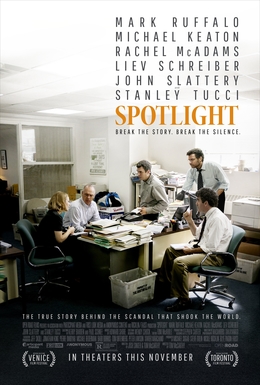
Spotlight in the Dark


“I am here because I care. We are going to tell this story and tell it right.”

Those are the words Spotlight investigative reporter Sacha Pfeiffer (Rachel McAdams) uses to convince an abuse survivor to share his story. That also seems to be the philosophy of the principals involved in the stellar production of “Spotlight.”

From the time the actors (including Mark Ruffalo, Michael Keaton, and Stanley Tucci) read the smart, layered script they knew that it was a special project. They were grateful to be working with colleagues they admired on such an important film, and they did their best to do it justice.

Spotlight” is the true story of how a team of investigative reporters from the Spotlight division of the Boston Globe uncovered a massive scandal of child molestation within the Catholic Archdiocese.

It is a rare picture that moves you without manipulating you with shocking, exploitative images. Writer/director Tom McCarthy and writer Josh Singer tell this story and tell it right – by treating the sensitive material with respect.

The real-life journalists (Editor Walter "Robby" Robinson, and reporters Michael Rezendes, Matt Carroll, and Sacha Pfeiffer) praised the filmmakers for their accurate portrayal of what investigative reporters do and for highlighting why their work is so important. Their Spotlight article gave a voice to the survivors who couldn’t speak up for themselves, and let them know that they weren’t the only victims.

Keeping that dirty secret was literally killing the victims. In the movie, a reporter notices track lines on a survivor’s arm. The survivor’s lawyer explains that he is one of the lucky ones because he is still alive. What made the movie so moving was how the survivors are portrayed as courageous for speaking out. They paid a huge personal price by opening those old wounds. But they did it to save children.

One survivor explained how he fell prey to the priest. “When you’re a poor kid from a poor family, and a priest pays attention to you, it’s a big deal. How do you say no to God?” The violation goes beyond just molestation. It is the breaking of faith that is so devastating - that your neighborhood priest, who represents God, took advantage of you.

But the reporters dug up a bigger story – the church superiors covering it up. The investigation is riveting. The dedicated reporters sift through layer after layer of the cover-ups throughout the institution: the Catholic Dioceses, the neighborhood parishes, and even the families themselves. The bishops had pressured the families not to speak of it, using the excuse that it was just this one case and you don’t want to hurt the church. The more the reporters dug, the more institutions they found that buried the crimes.

The tension rises as the reporters feel the powerful grip of the Catholic Church in Boston - while the threat of continuing abuse starts to hit home. (One of the pedophile priests has been relocated to a reporter’s neighborhood.)

The film reminds us why investigative reporting is so vital in a democratic society: It is crucial that the press be a watchdog to keep those in power in line, to hold powerful institutions and people accountable (including our government). The more power they have, the more temptation there is to abuse it.

“Spotlight” is the kind of movie that really gets you thinking. So I joined a couple of women in the lobby for a post-movie discussion. We pondered how devastating it must have been for faithful Catholics when this story broke – since they find strength in their religion and their church community. It is so troubling that this institution, whose mission is to aid children in need, would abuse that trust and abuse it hundreds of times - for three decades! “The problem isn’t with God, but the institution,” chimed in one of the women. “The institution is run by men and men are flawed.” The other woman remembered when the story came out. Her father, a devout Catholic, said he didn’t want to hear about it. He didn’t want it to shatter his faith in God or become disillusioned with the church. That attitude certainly played into the systemic problem. Everyone turned a blind eye. Everyone buried the story.  “If it takes a whole village to raise a child, it takes a village to abuse one.” That is why the work of investigative reporters is so important and must be upheld.

We are all in the dark, until we see the light. Until someone shines a “Spotlight” on it.

Movie blessings,
Jana Segal-Stormont
www.reelinspiration.blogspot.com


Oscar News: "Spotlight" WON Best Screenplay (Tom McCarthy and Josh Singer), and BEST PICTURE! 

"Spotlight" was also nominated for Best Director (Tom McCarthy), Best Editing, Best Supporting Actor (Mark Ruffalo) and Best Supporting Actress (Rachel McAdams).

Tuesday, May 05, 2015

"Still Alice"


I have some resistance to watching movies on Alzheimers since witnessing my friend Grace lose herself to the disease. I can only imagine how heart wrenching it was for her husband of sixty years to watch helplessly as the women he loved slipped away. I was so touched by their devotion that I moved in to allow them to spend their last days together in their home. This fueled strong feelings of frustration, shock, fear, hopelessness, anger and deep LOVE. I found writing about it therapeutic. Sensing that other people might find strength in their commitment, I drafted the screenplay, “Walking with Grace.” I struggled with how to show the reward in caring for someone in this devastating situation. “The Notebook,” did an amazing job at that. Whenever I happen onto that movie on TV, I get sucked into it again – because of the husband’s unflinching commitment to the love of his life. It chokes me up every time.

Since then, there have been several movies on Alzheimers. Most focus on family members coping with the loss of their loved ones.  I felt the subject had pretty much been covered.  Then I watched, “Still Alice" for Julianne Moore’s Oscar nominated performance. (She went on to win a well-deserved Best Actress Oscar.) Julianne conducted in-depth research with Alzheimers patients to really get into the mind of her character. After building relationships with them, she asked what they would like her to include about the disease. She incorporated their thoughts and feelings into her part. Those insights on how a patient deals with their loss of self is what sets this movie apart and makes it so powerful.

This is the poignant story of a brilliant linguist who recognizes that she is losing her ability to understand the meaning of even simple words. That awareness is the painful part. She sees her identity fading away and can’t bear the idea of living as a shell of her former self. She struggles to hold on to her connection with her precious words, her loved ones, and her life. “I am struggling to be a part of things, to stay connected to who I once was,” she explains. She comes to the realization that she must live in the present and enjoy her last moments with her loved ones because, “This might be the last year that I am totally myself.” She pleads with her husband to spend time with her now while she is still present, while she is, “Still Alice. “


This theme has even more impact when you discover that it was being demonstrated on the set every day. Wash Wastmoreland co-directed with his husband Richard Glatzer after Glatzer was diagnosed with the degenerative disease Amyotrophic Lateral Sclerosis (ALS). (Glatzer passed away in March of this year.) What a love project! Despite his inability to speak, Glatzer was fully present and in the moment as he communicated to the actors on his ipod, 

These amazing men remind us of the importance of loving and living fully in the moment. 

Movie blessings!
Jana Segal
www.reelinspiration.blogspot.com 

Wednesday, March 11, 2015

Why do I do what I do?


You could say that I started attending AIVF (Association of Independent Video and Filmmakers, now IFA) with the goal of finding an indie filmmaker to produce my screenplay. But what I found were indie filmmakers anxious to produce their own scripts, so I helped develop them.  Meanwhile, I saw a need for more advanced training for Tucson Filmmakers, so I organized workshops. I got caught up in helping our film community grow.

Now here’s the part that drives people crazy… It wasn't about the money. In order to provide workshops that were affordable enough for Tucson filmmakers, I couldn't pay myself. Did all this “networking” lead to paid jobs? No. I spent hours, then years, promoting films with my reviews, organizing film contests and networking events. I didn't make any money, but it was rewarding.

In this capitalistic society it seems the only thing people value anymore is the pursuit of money. I know how blessed I was to be a stay at home mom while developing my art. But it is really heartbreaking when your own children are disappointed in you because you’re not more “successful” by society’s standards. They don’t seem to  value my role as a mother. One question I hear a lot is, why aren't there more successful women filmmakers?  I can’t speak for anyone else, but for me some things are more important than money:  living a full, balanced life, raising creative children, building a film community, empowering filmmakers to make meaningful films, and writing (and sometimes directing) my love projects.

How come I never succeeded in getting my screenplays produced? Perhaps, between being a mom and pursuing my other passions, I didn't have the single-minded ambition needed to sell my script. Or perhaps it was because I wasn't willing to write something more commercial. All the stories I chose to write were love projects.  I never could wrap my mind around writing high concept movies for money.


One of my first love projects was, “Walking with Grace,” about a sweet elderly couple I had taken care of while attending grad school. When Grace’s husband couldn't deal with her mind deteriorating from Alzheimers, I moved in full-time to allow them to spend their last days together in their home. This story was very dear to my heart.

I spent an embarrassingly long time working on it. One reason was that people thought my story was depressing.  I workshopped it at the Frederick Douglas Creative Writing Center in New York City; writing draft after draft, trying to make it more upbeat. But what it came down to was that people couldn't understand why a young woman would sacrifice her life to take care of “strangers.” What was so hard to understand? I loved them!  I finally did a major rewrite changing my character into their granddaughter.

And I did shop it around. For years. I researched possible actors and production companies.  I pitched it at screenwriting conferences. I made phone calls.  I sent off query letters. Even got a hand-written letter from Hume Cronyn explaining how the story was too depressing because it hit so close to home. People suggested that I put it away and work on something more commercial. They said that once I had a big hit, I could parley that into the power to get my love project done.  I pitched it to the perfect producer - the producer of the family drama “Christy.” He made a special effort to encourage me. He said that it was good writing, but that no one would do a film about old people. (I still cringe at my lack of determination as I watch numerous Alzheimer movies flash across the screen: “Away From Her,” “Savages,” “Amour,” my favorite, “The Notebook," and the recent, “Still Alice.” It’s practically become a genre!)

At least I had the rare opportunity to see my screenplay performed as part of the staged-reading series at DamesRocket Theater. I watched, in the sold-out theater, as professional actors gave full-out emotional performances. A 50 year-old man was moved to tears because it reminded him of his father. That experience was so satisfying that I was finally able to put the script away and start concentrating on something new. Someone suggested that I might have a better chance selling the script if I adapted it into a novel (they were onto something there), but artistically it was time to move on.

I critiqued my mom’s (Lorna Kerin Beall) historical fiction book, “Model-T Biscuits,” and helped her draft a cover letter to market it. I even pitched it at local writers’ conferences when she couldn't afford to attend. Eventually, I was inspired to adapt this cherished family story to the screen. It was really a love project working with my mother and staying true to her vision. I think people could feel the love as they read it. We ended up winning first place at the Santa Clarita Family Film Festival and the Moondance Film Festival.

My mom, Lorna Beall, and me
 When Julianne Moore won an Oscar for her portrayal of an Alzheimers patient in, “Still Alice,” my boys asked why don't I sell, “Walking with Grace.” I just shook my head and smiled. I think Best Foreign Film winner, “Amour,” and, “Still Alice,” have it covered. But in this day when paying for defense is favored over healthcare or housing, when big business trumps the environment, we need more movies with themes of giving and responsibility. Maybe there’s hope for “Grace,” yet.

So I continue to write my love projects and encourage others to do the same.  Because, like the Dali Lama said, “The planet does not need more ‘successful people.’ The planet desperately needs more peacemakers, healers, restorers, storytellers and lovers of all kinds.”

Go ahead. Ask me why I do it.

One word...Love.

Saturday, February 28, 2015

"Nebraska"

Last year's Best Picture nominee, opens with a police car picking up a dazed, disoriented old man trudging down the highway. His family is dumbfounded as the booze-addled, obstinate Woody (Oscar nominated Bruce Dern) keeps setting off on a 900 mile trek across, "Nebraska," to claim his bogus million dollar sweepstakes winnings.

Nobody seems to know why he is doing it. And Oscar nominated director Alexander Payne doesn't give any easy answers. Perhaps it’s to avoid his eminent morality. (He says that he doesn't have much time.) Maybe it’s a last ditch effort to do something with his wasted life. He seems to have little to live for being stuck in a marriage with a woman he doesn't even like. We don’t know how long he has been numbing himself with liquor, but it’s been a while.

All of this could be very depressing, but Payne gives us comic relief in the form of Woody’s ornery, long suffering wife (Oscar nominated June Squibb) as the foul-mouthed voice of reason, “I never even knew the son of a bitch wanted to be a millionaire. He should have thought about that years ago and worked for it.”

Woody’s responsible son (Will Forte) is called in to talk some sense into the old man. But when Woody won’t be dissuaded, his son sees a chance to bond with the father he never knew. He takes some time off from his meaningless job as an electronics salesman to join him.

We see the story through his son’s tired, exasperated eyes. Like him, we long to uncover some meaning in this cross-country road trip. Perhaps Woody needs to reconnect with his family roots. But there is no satisfaction in the family reunion. The image embedded in my mind is of the men in the family all sitting in the bland living room facing the television set. Even after their long separation, the two brothers barely relate to each other aside from some complacent muttering about which sports teams are playing.

We feel the son’s rising frustration as he attempts to find some redeeming value in Woody’s life. He asks his father if he is ever sorry that he married his wife. Woody answers, “All the time.” “But you must have loved her once?” Not really. It seems that Woody has settled for this life. The son becomes more agitated as Woody keeps running off to get sloshed at local dives, spouting off about his big windfall. Woody offers comfort his irritated son, “Have a beer with your old man. Be somebody.”

The story livens up when his wife and other son come to “rescue” Woody. As the family deals with unresolved issues and greedy “friends” and relatives in his hometown, we see a little bit about what made Woody, woody. It is genuinely touching to see Woody’s squabbling wife finally stick up for him, explaining why he doesn't owe these people a damn thing!

Payne paints a stark portrait of family responsibility and the silent isolation and resignation of rural America.

Movie blessings!
Jana Segal
reelinspiration.blogspot.com

"Nebraska," was also nominated for Best Screenplay (Bob Nelson) and Best Picture in 2014.


Sunday, February 22, 2015

Oscars: Breaking into the Men's Club


OK. I’m gonna put it right out front and center (like Octavia Spencer's prominent seat at the Oscars.) This year there is not one film with a female lead nominated for Best Picture.

The male dominated academy doesn't seem to consider personal female stories of great enough importance to be nominated for Best Picture. They neglected to nominate, “Wild,” the empowering universal story of a woman’s journey for self-forgiveness, while testing herself on a grueling backpacking hike across the Pacific Crest Trail. Yet they nominated, “Whiplash,” the personal story of a young male drummer suffering for his art. “Boyhood,” the favorite to win Best Picture, is a personal story as well. But deserves attention for director Richard Linklater’s audacity in filming over the course of 12 years.

The Academy favors films about the accomplishments of great men – like this year’s inspiring nominees, “The Imitation Game,” and, “The Theory of Everything,” about a mathematician and scientist respectively. But where are women scientists or mathematicians and their world-changing accomplishments?

As a society, we need more biopics about these incredible women. It is important that their accomplishments be recognized. A few examples: Rear Admiral Grace Hopper has a destroyer named after her to honor her accomplishments including inventing the first compiler, and developing the first high level computer language. Rosalind Franklyn was instrumental in discovering the double helix structure of DNA for which her former collaborators Crick and Watson won the noble prize. This is one time I wish I was wrong. But I when I googled, “Women scientists in movies,” I found only lists of fictional scientists in SciFi films. Perusing the Best Actress nominations throughout the history of the Oscars, I found two movies about women scientists: “Madame Curie” (Marie Curie worked with physicist Pierre Curie to discover radium) back in 1943 and “Gorillas in the Mist” about Dian Fossey’s research with Mountain Gorillas in Africa. “Madame Curie,” was nominated for Best Picture, Best Actress (Greer Garson), Best Actor, and Best Cinematography, yet this accomplished biopic didn't win any academy awards. “Gorillas in the Mist,” was nominated for Best Adapted Screenplay and Best Actress (Sigourney Weaver) back in 1988.

Of course, great advancements don’t happen in a bubble. In the 1840s, Ada Lovelace worked on Charles Babbage’s early mechanical general-purpose computer, the Analytical Engine. Her notes on the engine include the first algorithm carried out by the machine. She is often described as the world’s first computer programmer.


Cooperation is one of the themes of, “The Imitation Game.” It took a team sharing their different strengths to break the code of the German Enigma cipher and win the war. It took military strategy, math skills, relationship strengths, and being able to see the whole picture. “Sometimes it is the people who no one imagines anything of who do things that no one can imagine.” Mathematician Alan Turing (Oscar nominated Benedict Cumberbatch) doesn't relate to the world like others do, but it is that difference of perception that allows him to create a machine to crack the enigma. No doubt Turing studied Ada Loveless’ work while at Princeton. That may be how he was able to recognize that Joan Clark’s (Keira Knightley) mathematical strengths would benefit the team. And it is also Joan who taught him to work together with the other team members in order to accomplish their goals.

The “Theory of Everything,” was based on the inspiring story of how Stephen Hawking, (Oscar winner Eddie Redmayne) was empowered and supported by his wife Jane (Oscar nominated Felicity Jones), and postulated the theoretical prediction that black holes emit radiation and researched a unifying theory of relativity and quantum mechanics while suffering from ALS disease that increasingly paralyzed him. While the movie doesn't cover the “Theory of Everything” or even Stephen’s scientific process in any depth, Director James Marsh illuminates the Hawkings' relationship and the world of science with spectacular poetry and wonder.

Now let’s get down to the Oscar snub. “Selma,” one of the best reviewed, most powerful films of the year didn't garner its director, Ava DuVernay, a Best Director nomination. (Read more about this in my previous review.) Like, “The Imitation Game,” it celebrates the accomplishment of a great man. But "Selma," concentrates on the community and collaboration. DuVernay realizes her vision by inviting the audience into the spirit of the Civil Rights movement from the point of view of its black protagonists. The movement (and resulting movie) was bigger than just one man. It was a community working together, and risking their lives, fighting for freedom for generations to come. DuVernay shows women as partners in the cause. Coretta Scott King enabled her husband to be the voice of the movement by supporting him financially while raising their children. Women and men lock arms and march bravely together.

While, "Selma," shows the effectiveness of collaboration and non-violent protest; "American Sniper," glorifies Chris Kyle as an indispensable, one-man killing machine. “American Sniper,” was produced to draw attention to the condition of vets returning from the war. That is certainly a noble purpose. But it is also a masterfully crafted propaganda movie (much like John Wayne's Vietnam War film, “The Green Berets," which wasn't nominated for an Oscar.) In, "American Sniper," there is no question that Chris Kyle was justified in killing every Iraqi because nearly every one of them was shown carrying a weapon. The theme of the movie is black and white. It is us against the evil terrorists. But what would you do if your neighborhood was occupied and soldiers were breaking into your house? I found it very disturbing when I started rooting for Chris to kill the evil terrorists. The film has already had its desired effect, as a Facebook friend commented, “We need to kill everyone of those evil bastards.” To me this is a misuse of the power of film.

I’m not ready to give up on the Oscars yet. The top runners for Best Picture: “Boyhood,”, “Birdman or (the Unexpected Virtue of Ignorance)," and, “The Grand Budapest Hotel,” all deserve their nominations.

It is a miracle that Linklater was able to pull off this unprecedented feat of shooting the same actors over the course of 12 years. No theme is imposed on, “Boyhood,” aside from memories projected over the passage of time. There is no big turning point that inspires the characters’ growth, just living through life’s daily struggles. This accumulates into something very moving over the course of the film and their lives.

Wes Anderson creates intricate details in the whimsical, quirky world of, “The Grand Budapest Hotel,” where the melancholy staff try to maintain bygone civility and loyalty amongst a backdrop of brutality, war and loss. The physical comedy is spot on and the action sequences thrilling and fun!

In Oscar-winning Director Alejandro González Iñárritu's, "Birdman (Or the Unexpected Virtue of Ignorance),” a comic book action star struggles to express himself as an artist, to find some relevance in his life, to prove that his life matters. It is a biting satire on the price of fame and how Hollywood clips the wings of its artists in their pursuit of profits.

All three films deserve their Best Picture nominations for brilliantly realizing their directors’ original visions. I just hope that next year the Academy chooses to empower women filmmakers by nominating them into the club.

Oscar blessings!
Jana Segal
www.reelinspiration.blogspot.com

OSCAR UPDATE:

Patricia Arquette won Best Actress for, "Boyhood" and gave an impassioned plea for equal rights for women in America.

The powerful performance of Best Song winner, "Glory," honoring, "Selma," along with the speeches by songwriters Common and John Legend moved many to tears.

Eddie Redmayne won Best Actor for, "The Theory of Everything."

Graham Moor won Best Adaptation for "The Imitation Game."

Alejandro González Iñárritu won Best Director, Best Picture and Best Original Screenplay (along with Nicolas Giacobone, Alexander Dinelaris Jr. and Armando Bo) for, "Birdman."


Congratulations to all the winners! 

Monday, February 02, 2015

"Dallas Buyers Club"


Whether it’s drunken bull riding, doing drugs off of prostitutes’ bellies, or getting in barroom brawls – real-life Texas cowboy Ron Woodroof (played with devastating honesty by Best Actor winner Matthew McConaughey) is reckless with his life. That is… until he is diagnosed as HIV-positive and told that he has 30 days to live. The good ol’ boy is ostracized by his friends for being what he detests the most – a homosexual. It is 1985 and the early days of the AIDS epidemic. Ron soon finds that there are no government approved HIV drugs. The “lucky” AIDS patients are being used as lab rats. This is where he meets personable transgender AIDS patient, Rayon (appropriately named after a fabricated material rather than the spun silk she deserves). When Rayon tries to befriend Ron, Ron gets skittish and flees. But Ron isn't about to lay down and die. He takes it on himself to track down alternative treatments. When he can’t afford the drugs on his own, he is forced to team up with street smart Rayon to bring in other patients. They bypass government regulations on selling illegal drugs by starting a Buyers Club where patients pay for memberships and get drugs for free. Rayon (Best Supporting Actor Jared Leto) is the heart and soul of the, “Dallas Buyers Club.” Through their shared struggle for dignity and acceptance, the men develop a grudging respect for each other. Ron Woodroof might be doing it for the wrong reasons (to provide drugs for himself and make money), but he ends up helping many AIDS patients and growing a little in the process.

Movie blessings!
Jana Segal
reelinspiration.blogspot.com

Thursday, January 29, 2015

"Philomena"

Last Year's Best Picture nominee, "Philomena," is based on the nonfiction book, "The Lost Child of Philomena Lee," by journalist Martin Sixsmith. For 50 years, “Philomena,” (Judi Dench) longed for the son who was taken from her by the nuns entrusted with their keeping. Ashamed of being an unwed mother, she kept that secret all those years. She sets off on a journey to find her son with political reporter, Martin Sixsmith (Steve Coogan). Martin isn't thrilled about doing a human interest story, but he needs the job.


As an ex-Roman Catholic, Martin voices an issue many can relate to – how the church shames people for having sex. “Why would God bestow on us a sexual desire that he then wants us to resist?” He can’t understand why Philomena would protect the very nuns who shamed the unwed mothers into indentured servitude and then sold off their babies. But Philomena’s faith is not limited to a flawed institution; it is built on God’s forgiveness.

Director Stephen Frears takes us on an “odd couple” road trip, steering clear of sappy MOW (Movie of the Week) pitfalls. Comic moments are accentuated by exaggerating their differences: Philomena’s small town naivety in contrast to Martin’s world-weary cynicism. Much of the humor comes from Philomena taking everything Martin says literally. When he politely asks her how she is, she goes on …and on…about her hip replacement. She is portrayed as a sort of "everymom." In the end, she doesn't want the story published because she is ashamed. While Martin finally understands the importance of sharing this “everymom” story - to help other mothers whose children were given up for adoption.

Movie blessings!
Jana Segal
www.reelinspiration.blogspot.com

Tuesday, January 27, 2015

"Captain Phillips"


In this thrilling, hard-driving action film, true-life sea captain Richard Phillips (Tom Hanks in his boy-next-door amicable best) is portrayed as a hard-working merchant mariner – responsible first to his duty (delivering cargo) and then for protecting his crew.

Cmdr Castellano and Capt Phillips of the USS Bainbridge
The film opens with Phillips expressing his growing concern about how with today’s economy his son won’t be able to find employment. This burden distracts him from seeing the negative impact of international companies: dumping nuclear waste off of the Somali coastline and illegally trolling for fish. (A theme that too many of us can relate to. In our daily struggle to keep a job, we don’t have the time or energy to register the impact of international trade on the rest of the world.)

In a ruthlessly realistic scene, we see the results: former Somali fishermen fighting over knat (an additive, green leaf) and to be hired for the only available job – a cargo ship pirate. It is only when Captain Phillips is thrown into a life and death struggle with the pirates (lead with fierce determination by Oscar nominated Barkhad Adbi) that he begins to understand their desperation. The movie isn't overly sympathetic to the pirates as it reveals that none of their bounty will be going back to help the rest of the village.

Capt Phillips was held captive by Somali pirates in this life boat 

As with the negative relationship between the global recession and global warming, there are no easy answers. “Captain Phillips” is a must-see for the rising tension in the action and in global trade.

Movie blessings! 
Jana Segal
www.reelinspiration.blogspot.com

"Captain Phillips" also received well-deserved nominations for:  Best Adapted Screenplay (Billy Ray), Best Editing (Christopher Rouse), and Best Picture. Paul Greengrass was cheated out of a Best Director nomination. "Captain Phillips," was my pick for Best Picture in 2014.

Sunday, January 25, 2015

"Nightcrawler" Thrilling Fable of the American Dream.

In my zeal to see the Oscar nominated films, I wasn’t in a hurry to watch, “Nightcrawler." From the trailer it appeared to be just another slick Hollywood thriller.  But since thrillers are more fun on the big screen, I figured I’d better catch it before it was pulled from the theater, replaced by the recent Best Picture nominees.

Nightcrawler,” is more than a thriller, it’s a fable about the American Dream.

Unable to find a job in this economy, Lou Bloom (award-winner Jake Gyllenhaal) is desperate to make a living. He is a wily night scavenger – stealing scrap metal or doing whatever he can to make money until he can find a way to get in the game. He tells a perspective employer that he works hard to get ahead, but he has to be in the game in order to win it. Like the American public, he has been sold the American Dream and will do anything to get it.  He happens onto a profitable way to make a living, videotaping gruesome crime scenes for the local news. He learns from another news videographer, (nightcrawler) that “if it bleeds, it leads.”  

An integral part of selling the American Dream are the images presented in the media. The viewers are the consumers buying the American Dream. Local news stations employ fear mongering to increase their ratings so they can sell more advertising, so corporations can sell more products to the consumer.

In, “Nightcrawler,” affluent people are the consumers that make the whole system work.  The media manipulates their fears to get them to watch the programs. The best-selling images show urban crime creeping into the suburbs. The local news station buys and sells images of bloody carjackings and home invasions perpetrated by minorities.

But writer/director Dan Gilroy pushes the envelope even farther by presenting the moral quandary:  How far would you go to get that money shot? When you get to the crime scene before the cops, do you get the graphic footage or do you help the victim? This is a metaphor for an important theme in politics today: capitalism vs. humanity.


The movie becomes even more frightening as we discover that Bloom will do absolutely anything to get the money shot.  His homeless “intern” Rick, (Riz Ahmed) isn’t a person to him at all, but a means to make more money. He doesn't take care of his one employee, but puts him in the line of fire. Through Rick’s eyes we see and feel the danger as their red Challenger speeds to the next crime scene.  Seen from his perspective inside the car, these are the most thrilling “chase scenes” I have ever experienced. My heart was in my throat through most of the movie. But what makes it scarier is that the female news editor (Rene Russo) has bought into this myth that we should do whatever it takes to make money. In this day and age, we reward sociopaths and accept them as players in our capitalistic society.  Only it’s happening in broad daylight.

If there is any justice in Hollywood, Dan Gilroy will win a Best Screenplay nod for his brilliant script. Why wasn't, "Nightcrawler,"- one of the most well-reviewed, entertaining movies of the year - nominated for best picture? I’ll leave that to you to figure out. Writer/director Dan Gilroy put together a great team that believed in his vision. Together they created the movie they wanted to make without interference from financial backers.  I call that inspiring.

Movie blessings!
Jana Segal
www.reelinspiration.blogspot.com

Thursday, January 22, 2015

The Long March to Freedom

The unwarranted controversy around Ava DuVernay's depiction of President Johnson in, "Selma," got me thinking about the challenge of writing a movie about historical figures. Being a writer, I know how difficult it is to write about a real person - especially someone who is as well-known and beloved as Martin Luther King or Nelson Mandela. The sheer scope of their life stories is daunting. What do you include and what do you leave out? How do you capture the life of a person in two hours? As an artist, you hope to capture a glimpse of their spirit. A writer attempts to create meaning out of life events. That is a tall order for men who meant so much to so many people. A friend of mine admitted that he didn't want to see, "Mandela: Long Walk to Freedom," because writer William Nicholson chose to include Mandela cheating on his first wife and endangering his family. Similarly, writer Paul Webb and director Ava DuVernay included this same weakness in their portrait of Martin Luther King. I believe that the writers showed great courage in sharing these great men's weaknesses. Illuminating the real men behind the legends is what makes these movies so powerful!

In both movies, their wives are portrayed as partners in the fight for civil rights. "Selma," makes it clear that Coretta enabled Martin Luther King to be the face of the civil rights movement by supporting him financially and caring for their children at home. The film concentrates on a shorter period in history to take a more personal look at Martin's and Coretta's relationship and the effect the struggles of the civil rights movement had on them. They risked their lives walking side by side at the peaceful demonstration in, "Selma" 

In, "Mandela: Long Walk to Freedom," Nelson’s story is contrasted with Winnie's tragic tale. While Mandela was in jail, it was his wife Winnie who led the Apartheid and Free Mandela movements. The movie captures her growing hatred as she witnesses violence towards her people and she endures torture at the hands of their white oppressors. When Mandela is finally released from prison, Winnie demands that he use his power to overthrow the white government. But the visionary Mandela finds the strength and wisdom to transcend the urge for revenge or justice. He has learned that the only way for Africa to be whole again is through cooperation and forgiveness.

What makes these movies so inspiring is that their subjects weren't perfect, but they accomplished great things. These flawed men and women sacrificed everything to bring freedom to their people.

Movie blessings! 
Jana Segal
reelinspiration.blogspot.com


OSCAR UPDATE:

"Selma," was honored with a Best Song Oscar for, "Glory," by songwriters Common and John Legend.

Monday, January 19, 2015

Celebrate Martin Luther King Day with, "Selma"


I went away from the screening feeling empowered to write an inspiring review of Best Picture Nominee,Selma.” I was deeply moved by the image of marchers from diverse religions, black and white, standing together against injustice and inhumanity. These people risked their lives for the rights we enjoy today. And the themes are still so relevant in this time of racial discord and disillusionment with those in power. 

After a two hour bus ride home, I was struggling to remember what I was going to write. I knew I wanted to include an excerpt from Martin Luther King’s closing speech at Montgomery, so I googled it. I was shocked to find that it wasn't King's actual words. I was appalled that the African-American filmmakers (including Oprah!) couldn't get the rights to use the speeches because of copyright laws. Doesn't Martin Luther King's legacy belong to all of us? The rights had been sold to a rich white man. Steven Spielberg will probably do justice to Martin Luther King’s life as he did with, “Schindler’s List.” But the symbolism is still disheartening – a rich white man buying up intellectual property for his vision of Martin Luther King. I was so thrown that I couldn't face writing this for days. 

Then there was the unwarranted controversy around the accuracy of the film's depiction of President Lyndon Johnson as a deterrent to the march at Selma. Personally, I feel that filmmakers have a responsibility to be truthful in capturing important historical events. I listened to director Ava DuVernay‘s explanation that, "Selma," was her artistic vision. She suggested that people research it for themselves. I took up the challenge and found that President Johnson's involvement was not black and white. He was first and foremost a Southern politician. While he may have intended to pass the civil rights law, he was cautious not to lose too many voters. I believe that the movie is DuVernay's honest take on the events. Her vision is to invite the audience into the spirit of the movement from the point of view of its black protagonists. Yes, protagonists - plural. It was greater than just one man. It was a community coming together to figure out the best way to accomplish their civil rights objectives.

The movie shows how African-Americans were humiliated, threatened with losing their jobs, beaten or even killed for attempting to vote in the South. A group of civil rights activists, including Martin Luther King (David Oyelowo), decide that the best course of action is to fight for the unobstructed right to vote. King meets with President Johnson (Tom Wilkinson) to request that he pass the Voting Rights Act. But the president’s goal is to keep a handle on the civil rights movement and he is interested in uncovering King’s next course of action. He claims that there is too much on his plate, including fighting poverty, to pass a Voting Rights Act.


The activists decide to bring attention to the issue by holding a non-violent demonstration in Selma, Alabama. As the protesters kneel down before Sheriff Jim Clark, a police officer strikes an elderly man who has difficulty kneeling. When two protesters intervene to protect the man, the police respond with a vicious attack. The protesters flee, but the policemen are unrelenting in their pursuit. One young man helps his family escape into a restaurant, where they pretend to be eating. The policemen track them down and shoot the young man in cold blood. Spurred on by this tragedy, the community rallies together. They organize a non-violent march from Selma.

Governor Wallace commissions Sheriff Jim Clark to teach them a lesson. When the peaceful marchers reach the end of a Edmund Pettus Bridge, Sheriff Jim Clark is waiting. He sics his armed state troopers on them. The nation watches, horrified, as the marchers are savagely beaten as white citizens cheer from the sidelines. Martian Luther King sends out a call to his fellow clergy to stand with him when they march again. Moved by the inhumanity, they come to show their support. It is inspiring to see black and white people from all religions joining arms and standing together.
 
The reason I wanted to include the excerpt from 
his Montgomery speech is that it still rings true today. Martin Luther King educates the nation on how after the emancipation, the Southern aristocracy was afraid of the freed slaves organizing with the poor whites for better working conditions, so they passed the Jim Crow segregation laws to separate them. The inherent message was no matter how low the white man was, the blacks were lower. (This is similar to the way our current politicians use undocumented immigrants as scapegoats, blaming them for causing the recession by taking the poor man’s jobs. Eighteen billion dollars was spent last year on immigrant enforcement. In Arizona, they passed a law that takes away our rights. Policemen can stop us on the street to ask for our papers. Of course, it is only brown-skinned people that they stop. Arizona has also disregarded the Voting Rights Act by requiring identification in order to vote.)

Witnessing the inhumane treatment of the marchers in Selma created more understanding of the plight of African Americans - which allowed President Lyndon Johnson to finally pass the Voting Rights Act in 1965. I hope that witnessing these events in, "Selma," will remind us of the difficult battle that was waged to achieve these rights, so we won’t allow them to be taken away.

Movie blessings!
Jana Segal
www.reelinspiration.blogspot.com

Fueled by Ava DuVernay's treatment, I wrote, "Incredible Invisible Women Filmmakers." Read more about it in Scott Mendelson's excellent article, "Why Ava DuVernay's "Selma" Oscar Snub Matters."


OSCAR UPDATE:

"Selma," was honored with the Best Song Oscar for, "Glory," by songwriters Common and John Legend. They made the most of the opportunity with this powerful rendition at the Oscar ceremony.


Wednesday, April 04, 2012

"Most Inspiring Films 2011!"


Here it is! My "Most Inspiring Films 2011!" list. These inspiring stories stayed in my heart and mind for months after I had seen them. A recurring theme this year - is the incredible strength we get from our connection with others to overcome even the greatest loss. I would love to hear about the films that moved you too! Please, share your thoughts and favorites in the comment section below.

10) "Midnight in Paris," is Woody Allen's love letter to Paris. For me it's total wish fulfilling escapism - a guilty pleasure. It is the story of a Hollywood screenwriter who joins his fiancee and her family on a business trip to Paris. The trip rekindles his dream of being a starving writer in Paris - much to the dismay of his materialistic fiancee. He takes a midnight walk and ends up in 1920's Paris. This is a dream come true for the aspiring novelist as he mingles with great artists (Picasso!) and his literary idols including Hemingway himself! This is one of the most enjoyable Woody Allen films to come out in years. The story flows effortlessly back in forth in time, earning Woody a well deserved Best Original Screenplay Oscar. 

9) In "The Tree," eight-year-old Simone is riding in the back of her father's pickup when it goes off track and rolls into the sprawling, twisted tree shading her house. Her family's world is turned upside down - not only by of the loss of their father, but also by the loss of their mother when she retreats into a deep depression. Unable to accept that her father is gone, Simone begins to hear her father's voice in the tree. To be near him, she climbs high into the branches and sets up house. At first her mother is worried, but then she finds comfort in the idea that her husband is there. The next morning, the children discover their mother curled up in the roots of the tree. These roots threaten to destroy the very foundation of the house. Mom must grow up and find the strength within herself to protect her family. "The Tree" is captivating in its beauty, riveting in its action sequences, and poetic in its symbolism. It has a valuable theme on the importance of pulling together as a family to survive loss.

8) “Where were you when I laid the earth's foundation... while the morning stars sang together and all the sons of God shouted for joy?” "The Tree of Life" is a reflection on the meaning of life. The filmmaker uses the opening narration to give us a handle on how to understand the nature images and memories to follow. The mother meditates, "There are two ways through life – the way of nature and the way of grace. We have to choose the way we will follow.” Basically, nature is competitive and only cares for itself while grace relies on a sense of oneness with all of existence. Soon after the opening images and narration, we witness the family getting the news that one of their three sons has died. They try to make sense of the loss. This brings on a lot of soul searching about how the children were raised and inspires prayers requesting understanding of the meaning of life, suffering, and death.

7) Distracted by the appearance of "Another Earth" in the sky, Rhoda drives into a family's car killing mother and son and leaving the father in a coma. After being released from prison, Rhoda seems to be serving a self-induced penitence when she accepts a job as a school janitor. The radio announcer confirms that the earth has been duplicated. “There's another you out there. Has that 'me' made the same mistakes as I made? Maybe the other me made a better choice." Recognizing the opportunity for a second chance, Rhoda enters an essay contest to win a shuttle ride to Earth II. But everything changes when she sees a man leaving a toy robot by the side of the road where the accident happened. "Another Earth," looks like sci fi, but it is actually a very human drama. The discovery of Earth II acts as the framework to explore the life we create with our bad choices, the inherent regrets, self-forgiveness, and redemption. Despite the tragic circumstances; it is really a story of hope.

6) First off, I will admit that I am a fan. I am completely captivated by the fanciful flights of the imagination in the magical world of, "Harry Potter." If it were on TV right now, I would be watching Harry and his friends' quest to find and destroy Lord Voldemort's Horcruxes (the instruments of his power.) Because, "Harry Potter and the Deathly Hallows, Part 2" was one of the most compelling, suspenseful, awe-inspiring movies of the year and definitely the most satisfying ending to a franchise EVER.

5) Best Picture winner, "The Artist" is more than a homage to the silent film era, it transcends the form. Bigger-than-life movie star George Valentin (Best Actor winner Jean Dujarin) fades into oblivion with the decline of silent pictures as his young love interest, Peppy Miller, rises to stardom with the talkies. French director (Best Director winner) Michel Hazanavicius reinvents silent pictures by using a naturalistic, charismatic acting style and exquisite cinematography. You can see the love in every frame.

4) In, "The Help," recent college grad Skeeter is hired to write a housekeeping and cooking column – a subject she knows nothing about. She asks her bridge club friend if she can interview her maid Abileen. Upset by her friend's mistreatment of Abileen, Skeeter is inspired to write a book on the maids' perspective of working for a white family. Her editor reminds her that it is 1960 Jackson, Mississippi. She will never be able to get any maids willing to risk their jobs or their lives to talk to her. Skeeter explains, “We are raised by our black maids. They love us and we love them, but they can't use the same bathroom.” But it's the maids that make the story. Viola Davis, as Abileen, adds gravity to every scene she is in. In her carriage we see the weight of generations of oppression. But it's her friend Minny (Best Supporting Actor winner Octavia Spencer) you have to watch. After working for the segregationist bridge club president, Minny has had enough. She is a firecracker ready to explode. These women are survivors. But they have risen above that. They have stood up to their fears. They are heroes in their own civil rights protest and free women.

3) In, “The Descendants,” Alexander Payne and Oscar winning co-writers Nat Faxon and Jim Rash present a flawed main character - absentee husband and father Matt King (played with good humor by George Clooney). Sometimes it takes a catastrophic event to shake us awake from sleep walking through life. When his wife ends up in a coma, Matt is absolutely clueless about how to handle the life shattering situation and his two troubled daughters. Matt must come to an understanding of his wife's infidelity before he can fully be there for them.

2) "Extremely Loud and Incredibly Close." According to his dad, the way Oskar sees the world is a gift. Oskar's overly active mind continuously scrutinizes the connections he observes in order to make sense of the physical world. Things he can't observe - like people's feelings - are elusive and frightening to him. His dad would challenge him by sending him on reconnaissance missions (to learn to talk to people.) When his father is killed in the 9/11 tragedy, Oskar is ill-equipped to make sense of the senseless act. Then he discovers a key in an envelope with the word BLACK written on it and a newspaper clipping indicating that he should keep looking. Did his father leave him one last message locked away somewhere in the city that only this key can open? As Oskar compulsively traverses the five boroughs in search of the lock, he inadvertently learns the lessons his father set out to teach him about connecting with other people. The quest gives him a concrete method to deal with a tragedy that makes no sense.

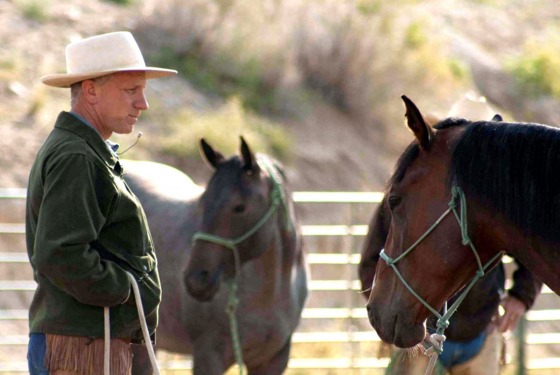
1) "Buck" is a pret'near perfect picture. You have your likable hero, Buck Brannaman, a wounded soul who overcame an abusive childhood and personal weaknesses to forge a better path in training horses. His experience taught him to be an empathetic, intuitive reader of horses and people. The thing that really stands out in this film is its humanity. Through working with their horses, the owners are transformed. They learn to let go of trying to force their will on others. “If you find a way to fit this thing right here, it'll make you better. It'll make you better in areas you didn't think related to horses.”

Movie blessings!
Jana Segal

*SCROLL DOWN FOR LONGER REVIEWS OF THESE MOVIES BELOW.